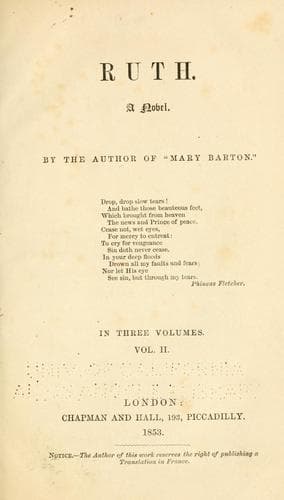
Domestic fiction; England -- Fiction; Mothers and sons -- Fiction; Religious fiction; Unmarried mothers -- Fiction
It seemed to the poor child as if Mrs Mason's words were irrevocable,
and, that being so, she was shut out from every house. She saw how
much she had done that was deserving of blame, now when it was too
late to undo it. She knew with what severity and taunts Mrs Mason had
often treated her for involuntary failings, of which she had been
quite unconscious; and now she had really done wrong, and shrank
with terror from the consequences. Her eyes were so blinded by the
fast-falling tears, she did not see (nor had she seen would she have
been able to interpret) the change in Mr Bellingham's countenance, as
he stood silently watching her. He was silent so long, that even in
her sorrow she began to wonder that he did not speak, and to wish to
hear his soothing words once more.
"It is very unfortunate," he began, at last; and then he stopped;
then he began again: "It is very unfortunate; for, you see, I did not
like to name it to you before, but, I believe--I have business, in
fact, which obliges me to go to town to-morrow--to London, I mean;
and I don't know when I shall be able to return."
"To London!" cried Ruth; "are you going away? Oh, Mr Bellingham!" She
wept afresh, giving herself up to the desolate feeling of sorrow,
which absorbed all the terror she had been experiencing at the idea
of Mrs Mason's anger. It seemed to her at this moment as though she
could have borne everything but his departure; but she did not speak
again; and after two or three minutes had elapsed, he spoke--not in
his natural careless voice, but in a sort of constrained, agitated
tone.
"I can hardly bear the idea of leaving you, my own Ruth. In such
distress, too; for where you can go I do not know at all. From
all you have told me of Mrs Mason, I don't think she is likely to
mitigate her severity in your case."
No answer, but tears quietly, incessantly flowing. Mrs Mason's
displeasure seemed a distant thing; his going away was the present
distress. He went on:
"Ruth, would you go with me to London? My darling, I cannot leave
you here without a home; the thought of leaving you at all is pain
enough, but in these circumstances--so friendless, so homeless--it is
impossible. You must come with me, love, and trust to me."
Still she did not speak. Remember how young, and innocent, and
motherless she was! It seemed to her as if it would be happiness
enough to be with him; and as for the future, he would arrange and
decide for that. The future lay wrapped in a golden mist, which she
did not care to penetrate; but if he, her sun, was out of sight and
gone, the golden mist became dark heavy gloom, through which no hope
could come. He took her hand.
"Will you not come with me? Do you not love me enough to trust me?
Oh, Ruth," (reproachfully), "can you not trust me?"
She had stopped crying, but was sobbing sadly.
"I cannot bear this, love. Your sorrow is absolute pain to me; but it
is worse to feel how indifferent you are--how little you care about
our separation."
Public-domain text, read in full here on John Shaqi.
Reviews
Reviews
No reviews yet
Be the first to share your thoughts on this work.
Join the Discussion
Join the discussion
Sign in to leave a comment or review.
Sign InorCreate an account