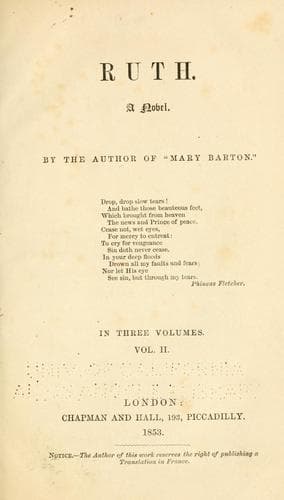
Domestic fiction; England -- Fiction; Mothers and sons -- Fiction; Religious fiction; Unmarried mothers -- Fiction
She sat silent, thinking for a little while, and then sent for her
writing-case, and began to write. Her son became restless, and
nervously irritated.
"Mother," he said, "this affair worries me to death. I cannot shake
off the thoughts of it."
"Leave it to me, I'll arrange it satisfactorily."
"Could we not leave to-night? I should not be so haunted by this
annoyance in another place. I dread seeing her again, because I fear
a scene; and yet I believe I ought to see her, in order to explain."
"You must not think of such a thing, Henry," said she, alarmed at
the very idea. "Sooner than that, we will leave in half an hour, and
try to get to Pen trê Voelas to-night. It is not yet three, and the
evenings are very long. Simpson should stay and finish the packing;
she could go straight to London and meet us there. Macdonald and
nurse could go with us. Could you bear twenty miles, do you think?"
Anything to get rid of his uneasiness. He felt that he was not
behaving as he should do, to Ruth, though the really right never
entered his head. But it would extricate him from his present
dilemma, and save him many lectures; he knew that his mother, always
liberal where money was concerned, would "do the thing handsomely,"
and it would always be easy to write and give Ruth what explanation
he felt inclined, in a day or two; so he consented, and soon lost
some of his uneasiness in watching the bustle of the preparation for
their departure.
All this time Ruth was quietly spending in her room, beguiling the
waiting, weary hours, with pictures of the meeting at the end.
Her room looked to the back, and was in a side-wing away from the
principal state apartments, consequently she was not roused to
suspicion by any of the commotion; but, indeed, if she had heard
the banging of doors, the sharp directions, the carriage-wheels,
she would still not have suspected the truth; her own love was too
faithful.
It was four o'clock and past, when some one knocked at her door,
and, on entering, gave her a note, which Mrs Bellingham had left.
That lady had found some difficulty in wording it, so as to satisfy
herself, but it was as follows:
My son, on recovering from his illness, is, I thank God,
happily conscious of the sinful way in which he has been
living with you. By his earnest desire, and in order to
avoid seeing you again, we are on the point of leaving
this place; but before I go, I wish to exhort you to
repentance, and to remind you that you will not have your
own guilt alone upon your head, but that of any young man
whom you may succeed in entrapping into vice. I shall
pray that you may turn to an honest life, and I strongly
recommend you, if indeed you are not 'dead in trespasses
and sins,' to enter some penitentiary. In accordance
with my son's wishes, I forward you in this envelope a
bank-note of fifty pounds.
MARGARET BELLINGHAM.
Public-domain text, read in full here on John Shaqi.
Reviews
Reviews
No reviews yet
Be the first to share your thoughts on this work.
Join the Discussion
Join the discussion
Sign in to leave a comment or review.
Sign InorCreate an account