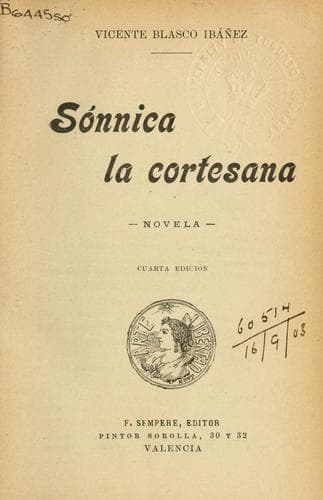
Sagunto (Spain) -- History -- Siege, 219-218 B.C. -- Fiction
In the centre of the square swarmed the multitude, buying and dickering,
dressed in a thousand colors, and speaking diverse tongues. The virtuous
women of the city, simply dressed in white, passed along, followed by
slaves who deposited in netted sacks the provision for the week; the
Greeks, in long, saffron-colored chlamydes investigated everything,
haggling tediously before making an insignificant purchase; the
Saguntine citizens, Iberians who had lost their primitive rudeness
through infinite intermarriages, imitated the manner and bearing of the
Romans who were at the moment the people in highest esteem. Mingled with
these were natives from the interior, bearded, begrimed, with long
dishevelled hair, attracted by the market in spite of their dislike for
the city, and particularly for the Greeks on account of their refinement
and riches.
Some Celtiberians, chiefs of the tribes nearest to Saguntum, remained on
horseback in the centre of the Forum, without putting aside their
lances, and still clinging to their shields of woven bull-sinews. They
wore triple-crested helmets and leather cuirasses, as if they were on
hostile soil and feared treachery. Meanwhile their women, agile, brown,
and masculine, moved from place to place, their ample vestments,
embroidered in gayly colored flowers, fluttering as they walked, and
anon they stopped with childish admiration before the table of some
Greek selling crystal beads and coarsely engraved necklaces and trinkets
of bronze.
Mantles of finest linen and costly purple brushed against the naked
limbs of slaves or against the Celtiberian sagum of black wool buckled
at the shoulder. Coiffures in Grecian style with red ribbons plaited in,
the tuft of curls at the back of the head resembling the flame of a
torch, the forehead small as a sign of supreme beauty, mingled with
coiffures of the Celtiberian women, who wore their foreheads shaven and
shiny to make them larger, their hair curled around a little stick
placed on their heads, forming a sharp horn from which hung a black
veil. Other Celtiberian women wore strong steel collars with little
wires which were brought together above the coiffure, and from this
cage, which enclosed the head, hung the veil, proudly displaying their
enormous foreheads, brilliant and luminous as the moon in her first
quarter.
Actæon lingered wondering at the costumes of these women, and at their
masculine and warlike aspect. His quick Grecian perceptions divined
danger as he contemplated the barbarians motionless on their steeds in
the centre of the Forum, from that height dominating with looks of
hatred this nation of merchants and farmers. They were like birds of
prey that were compelled to come down to the plain as thieves in order
to find food for existence in their arid mountains. Saguntum surrounded
by such peoples would some day have to struggle for supremacy against
them.
Public-domain text, read in full here on John Shaqi.
Reviews
Reviews
No reviews yet
Be the first to share your thoughts on this work.
Join the Discussion
Join the discussion
Sign in to leave a comment or review.
Sign InorCreate an account