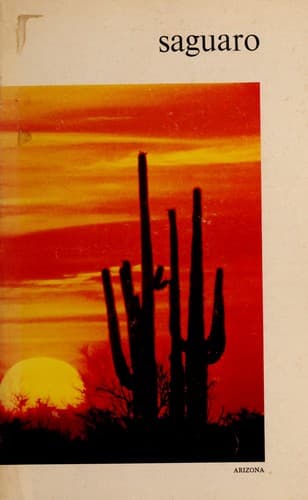
Desert ecology -- Arizona -- Saguaro National Park; Natural history -- Arizona -- Saguaro National Park
On either side of the Santa Cruz Valley in southeastern Arizona, Saguaro
National Monument embraces two of these ranges, with the desert lands at
their feet. Although it was established primarily to preserve impressive
stands of saguaros, it gains wholeness by including the mountains that
shed the rocky soil on which the saguaros grow. The monument is in two
sections, some 30 miles apart. The _Rincon Mountain Section_, east of
Tucson, includes in its 99 square miles a spectrum of plantlife ranging
from saguaro communities at the low elevations to a wet fir forest on
the north slope of 8,666-foot Mica Mountain. The 24-square-mile _Tucson
Mountain Section_, about 12 miles west of the city, has a denser stand
of saguaros, on the lower slopes of a wild jumble of volcanic mountains
dominated by 4,687-foot Wasson Peak.
Within the cactus forests and upon the mountain slopes, life in myriad
forms goes on in a delicate and continuous adjustment to changing
environments. Over millennia, mountains rise and crumble, species evolve
and fade from the scene. Over days and weeks and years, populations of
plants and animals rise and fall, in response to thousands of
interactions which we are only beginning to understand. In the following
pages, we will meet the main characters in this natural drama (including
some of the most improbable in all of nature); we will investigate the
environmental stage upon which they perform; and we will try to
understand something of the play itself, including our own role in it.
[Illustration: The Saguaro Forest in the Tucson Mountain Section.]
the sonoran desert
and the monument
Saguaro National Monument is at the northeastern edge of the Sonoran
Desert. Named for the state of Sonora, Mexico, in which the greater part
of it lies, this, one of four major deserts in North America, is
distinguished by differences in climate and vegetation. The Great Basin
Desert, mainly in Nevada and Utah between the Rockies and the Sierra
Nevada, has cold winters, sparse precipitation distributed fairly evenly
throughout the year, and rather simple vegetation dominated by the low
shrubs, sagebrush and saltbrush. Immediately to the south, in southern
Nevada and southeastern California, is the Mohave Desert, with cool
winters during which most of the year’s precipitation comes, and with
plant cover consisting mostly of shrubs such as creosotebush. At higher
elevations grows the Joshua-tree, a giant yucca. The Chihuahuan Desert,
with cool winters and summer rainfall, covers the broad plateau of
north-central Mexico, extending into southern New Mexico and west Texas.
Its vegetation consists mostly of small cactuses, spiny shrubs, and
succulent-leaved plants such as yuccas.
Public-domain text, read in full here on John Shaqi.
Reviews
Reviews
No reviews yet
Be the first to share your thoughts on this work.
Join the Discussion
Join the discussion
Sign in to leave a comment or review.
Sign InorCreate an account