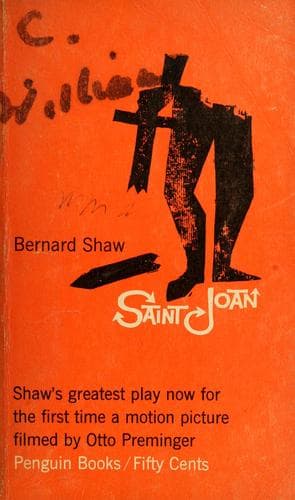
Saint Joan : $b A chronicle play in six scenes and an epilogueShaw, Bernard
HistoryHistory
Saint Joan : $b A chronicle play in six scenes and an epilogue
Shaw, Bernard
Christian women saints -- Drama; France -- History -- Charles VII, 1422-1461 -- Drama; Joan, of Arc, Saint, 1412-1431 -- Drama
When we jump over two centuries to Schiller, we find Die Jungfrau von
Orleans drowned in a witch’s caldron of raging romance. Schiller’s Joan
has not a single point of contact with the real Joan, nor indeed with
any mortal woman that ever walked this earth. There is really nothing to
be said of his play but that it is not about Joan at all, and can hardly
be said to pretend to be; for he makes her die on the battlefield,
finding her burning unbearable. Before Schiller came Voltaire, who
burlesqued Homer in a mock epic called La Pucelle. It is the fashion to
dismiss this with virtuous indignation as an obscene libel; and I
certainly cannot defend it against the charge of extravagant indecorum.
But its purpose was not to depict Joan, but to kill with ridicule
everything that Voltaire righteously hated in the institutions and
fashions of his own day. He made Joan ridiculous, but not contemptible
nor (comparatively) unchaste; and as he also made Homer and St Peter and
St Denis and the brave Dunois ridiculous, and the other heroines of the
poem very unchaste indeed, he may be said to have let Joan off very
easily. But indeed the personal adventures of the characters are so
outrageous, and so Homerically free from any pretence at or even
possibility of historical veracity, that those who affect to take them
seriously only make themselves Pecksniffian. Samuel Butler believed The
Iliad to be a burlesque of Greek Jingoism and Greek religion, written by
a hostage or a slave; and La Pucelle makes Butler’s theory almost
convincing. Voltaire represents Agnes Sorel, the Dauphin’s mistress,
whom Joan never met, as a woman with a consuming passion for the
chastest concubinal fidelity, whose fate it was to be continually
falling into the hands of licentious foes and suffering the worst
extremities of rapine. The combats in which Joan rides a flying donkey,
or in which, taken unaware with no clothes on, she defends Agnes with
her sword, and inflicts appropriate mutilations on her assailants, can
be laughed at as they are intended to be without scruple; for no sane
person could mistake them for sober history; and it may be that their
ribald irreverence is more wholesome than the beglamored sentimentality
of Schiller. Certainly Voltaire should not have asserted that Joan’s
father was a priest; but when he was out to _écraser l’infâme_ (the
French Church) he stuck at nothing.
Public-domain text, read in full here on John Shaqi.
Reviews
Reviews
No reviews yet
Be the first to share your thoughts on this work.
Join the Discussion
Join the discussion
Sign in to leave a comment or review.
Sign InorCreate an account