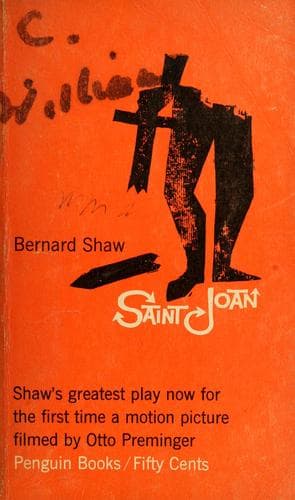
Saint Joan : $b A chronicle play in six scenes and an epilogueShaw, Bernard
HistoryHistory
Saint Joan : $b A chronicle play in six scenes and an epilogue
Shaw, Bernard
Christian women saints -- Drama; France -- History -- Charles VII, 1422-1461 -- Drama; Joan, of Arc, Saint, 1412-1431 -- Drama
They had, however, one disability in common. To understand Joan’s
history it is not enough to understand her character: you must
understand her environment as well. Joan in a nineteenth-twentieth
century environment is as incongruous a figure as she would appear were
she to walk down Piccadilly today in her fifteenth century armor. To see
her in her proper perspective you must understand Christendom and the
Catholic Church, the Holy Roman Empire and the Feudal System, as they
existed and were understood in the Middle Ages. If you confuse the
Middle Ages with the Dark Ages, and are in the habit of ridiculing your
aunt for wearing “medieval clothes,” meaning those in vogue in the
eighteen-nineties, and are quite convinced that the world has progressed
enormously, both morally and mechanically, since Joan’s time, then you
will never understand why Joan was burnt, much less feel that you might
have voted for burning her yourself if you had been a member of the
court that tried her; and until you feel that you know nothing essential
about her.
That the Mississippi pilot should have broken down on this
misunderstanding is natural enough. Mark Twain, the Innocent Abroad, who
saw the lovely churches of the Middle Ages without a throb of emotion,
author of A Yankee at the Court of King Arthur, in which the heroes and
heroines of medieval chivalry are guys seen through the eyes of a street
arab, was clearly out of court from the beginning. Andrew Lang was
better read; but, like Walter Scott, he enjoyed medieval history as a
string of border romances rather than as the record of a high European
civilization based on a catholic faith. Both of them were baptized as
Protestants, and impressed by all their schooling and most of their
reading with the belief that Catholic bishops who burnt heretics were
persecutors capable of any villainy; that all heretics were Albigensians
or Husites or Jews or Protestants of the highest character; and that the
Inquisition was a Chamber of Horrors invented expressly and exclusively
for such burnings. Accordingly we find them representing Peter Cauchon,
Bishop of Beauvais, the judge who sent Joan to the stake, as an
unconscionable scoundrel, and all the questions put to her as “traps” to
ensnare and destroy her. And they assume unhesitatingly that the two or
three score of canons and doctors of law and divinity who sat with
Cauchon as assessors, were exact reproductions of him on slightly less
elevated chairs and with a different headdress.
Comparative Fairness of Joan’s Trial.
Public-domain text, read in full here on John Shaqi.
Reviews
Reviews
No reviews yet
Be the first to share your thoughts on this work.
Join the Discussion
Join the discussion
Sign in to leave a comment or review.
Sign InorCreate an account