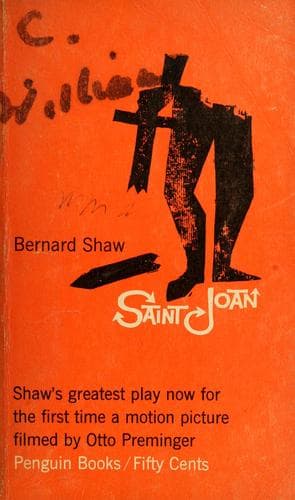
Saint Joan : $b A chronicle play in six scenes and an epilogueShaw, Bernard
HistoryHistory
Saint Joan : $b A chronicle play in six scenes and an epilogue
Shaw, Bernard
Christian women saints -- Drama; France -- History -- Charles VII, 1422-1461 -- Drama; Joan, of Arc, Saint, 1412-1431 -- Drama
Here then we have a reason why my drama of Saint Joan’s career, though
it may give the essential truth of it, gives an inexact picture of some
accidental facts. It goes almost without saying that the old Jeanne
d’Arc melodramas, reducing everything to a conflict of villain and hero,
or in Joan’s case villain and heroine, not only miss the point entirely,
but falsify the characters, making Cauchon a scoundrel, Joan a prima
donna, and Dunois a lover. But the writer of high tragedy and comedy,
aiming at the innermost attainable truth, must needs flatter Cauchon
nearly as much as the melodramatist vilifies him. Although there is, as
far as I have been able to discover, nothing against Cauchon that
convicts him of bad faith or exceptional severity in his judicial
relations with Joan, or of as much anti-prisoner, pro-police, class and
sectarian bias as we now take for granted in our own courts, yet there
is hardly more warrant for classing him as a great Catholic churchman,
completely proof against the passions roused by the temporal situation.
Neither does the inquisitor Lemaître, in such scanty accounts of him as
are now recoverable, appear quite so able a master of his duties and of
the case before him as I have given him credit for being. But it is the
business of the stage to make its figures more intelligible to
themselves than they would be in real life; for by no other means can
they be made intelligible to the audience. And in this case Cauchon and
Lemaître have to make intelligible not only themselves but the Church
and the Inquisition, just as Warwick has to make the feudal system
intelligible, the three between them having thus to make a twentieth
century audience conscious of an epoch fundamentally different from its
own. Obviously the real Cauchon, Lemaître, and Warwick could not have
done this: they were part of the Middle Ages themselves, and therefore
as unconscious of its peculiarities as of the atomic formula of the air
they breathed. But the play would be unintelligible if I had not endowed
them with enough of this consciousness to enable them to explain their
attitude to the twentieth century. All I claim is that by this
inevitable sacrifice of verisimilitude I have secured in the only
possible way sufficient veracity to justify me in claiming that as far
as I can gather from the available documentation, and from such powers
of divination as I possess, the things I represent these three exponents
of the drama as saying are the things they actually would have said if
they had known what they were really doing. And beyond this neither
drama nor history can go in my hands.
Some well-meant Proposals for the Improvement of the Play.
Public-domain text, read in full here on John Shaqi.
Reviews
Reviews
No reviews yet
Be the first to share your thoughts on this work.
Join the Discussion
Join the discussion
Sign in to leave a comment or review.
Sign InorCreate an account