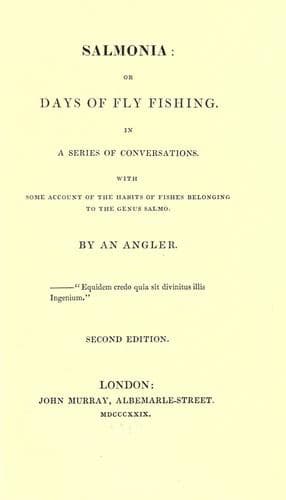
Salmonia; Or, Days of Fly Fishing: In a series of conversations. With some account of the habits of fishes belonging to the genus Salmo — John Shaqi
Salmonia; Or, Days of Fly Fishing: In a series of conversations. With some account of the habits of fishes belonging to the genus SalmoDavy, Humphry, Sir
Philosophy
Salmonia; Or, Days of Fly Fishing: In a series of conversations. With some account of the habits of fishes belonging to the genus Salmo
Davy, Humphry, Sir
Fishing
POIET.—This last is, in my opinion, the most poetical object in nature.
I will not fail to obey your summons. Pliny has, as well as I recollect,
compared a river to human life. I have never read the passage in his
works, but I have been a hundred times struck with the analogy,
particularly amidst mountain scenery. The river, small and clear in its
origin, gushes forth from rocks, falls into deep glens, and wantons and
meanders through a wild and picturesque country, nourishing only the
uncultivated tree or flower by its dew or spray. In this, its state of
infancy and youth, it may be compared to the human mind in which fancy
and strength of imagination are predominant—it is more beautiful than
useful. When the different rills or torrents join, and descend into the
plain, it becomes slow and stately in its motions; it is applied to move
machinery, to irrigate meadows, and to bear upon its bosom the stately
barge;—in this mature state, it is deep, strong, and useful. As it flows
on towards the sea, it loses its force and its motion, and at last, as
it were, becomes lost, and mingled with the mighty abyss of waters.
HAL.—One might pursue the metaphor still further, and say, that in its
origin—its thundering and foam, when it carries down clay from the bank,
and becomes impure, it resembles the youthful mind, affected by
dangerous passions. And the influence of a lake, in calming and clearing
the turbid water, may be compared to the effect of reason in more mature
life, when the tranquil, deep, cool and unimpassioned mind is freed from
its fever, its troubles, bubbles, noise and foam. And, above all, the
sources of a river—which may be considered as belonging to the
atmosphere—and its termination in the ocean, may be regarded as imaging
the divine origin of the human mind, and its being ultimately returned
to, and lost in, the Infinite and Eternal Intelligence from which it
originally sprung.
SECOND DAY.
HALIEUS—POIETES—ORNITHER—PHYSICUS.
TROUT FISHING, DENHAM.—MAY, 1810.
_Morning._
HAL.—I AM delighted to see you, my worthy friends, on the banks of the
Colne; and am happy to be able to say, that my excellent host has not
only made you free of the river for this day’s angling, but insists upon
your dining with him,—wishes you to try the evening fishing, and the
fishing to-morrow morning,—and proposes to you, in short, to give up
twenty-four hours to the delights of an angler’s May-day.
POIET.—We are deeply indebted to him; and I hardly know how we can
accept his offer, without laying ourselves under too great an
obligation.
HAL.—Fear not: he is as noble minded a man as ever delighted in good
offices; and so benevolent, that I am sure he will be almost as happy in
knowing you are amused, as you can be in your sport; and he hopes for an
additional satisfaction in the pleasure of your conversation.
POIET.—So let it be.
Public-domain text, read in full here on John Shaqi.
Reviews
Reviews
No reviews yet
Be the first to share your thoughts on this work.
Join the Discussion
Join the discussion
Sign in to leave a comment or review.
Sign InorCreate an account