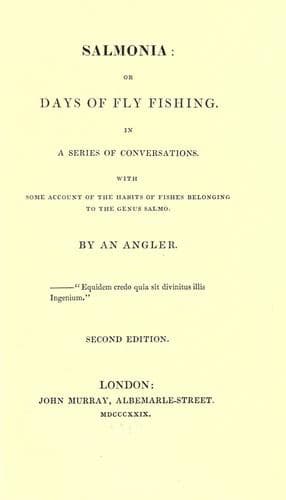
Salmonia; Or, Days of Fly Fishing: In a series of conversations. With some account of the habits of fishes belonging to the genus SalmoDavy, Humphry, Sir
Philosophy
Salmonia; Or, Days of Fly Fishing: In a series of conversations. With some account of the habits of fishes belonging to the genus Salmo
Davy, Humphry, Sir
Fishing
HAL.—However full a river may be of trout and grayling, there is a
certain limit to the sport of the angler, if continuous fishing be
adopted in the same pools. Every fish is in its turn made acquainted by
diurnal habit with the artificial fly, and either taken or rendered
cautious; so that, in a river fished much by one or two good anglers,
many fish cannot be caught, except under peculiar circumstances of very
windy, rainy, or cloudy weather, when many flies come on; or at night,
or at the time the water is slightly coloured by a flood, or when fish
change their haunts in consequence of a great inundation. In the Usk, in
Monmouthshire, when it was very full of fish in the best fishing time,
when the spring brown and dun flies were on the water, it was not usual
for some excellent anglers, who composed a party of nine, and who fished
in this river for ten continuous days, to catch more than two or three
fish each person. But one day, when the water was coloured by a flood,
in which case the artificial fly could not be distinguished by the fish
from the natural fly, I caught twelve or fourteen of the same fish, that
had been in the habit of refusing my flies for many days successively.
This was in the end of March, 1809, when the flies always came on the
water with great regularity; the blues in dark days, the browns in
bright days, between twelve and two o’clock in the middle of the day. In
rivers where the artificial fly has never been used, I believe all the
fish will mistake good imitations for natural flies, and in their turn,
to use an angler’s phrase, “taste the steel;” but even very imperfect
imitations and coarse tackle, which are only successful at night or in
turbid water, are sufficient to render fish cautious. This I am
convinced of, by observing the difference of the habits of fish in
strictly preserved streams, and in streams where even peasants have
fished with the coarsest tackle. I might quote the Traun at Ischl, where
the native fisherman used three or four of the coarsest flies on the
coarsest hair links made of four or five or six hairs, and the Traun at
Gmunden, where they are not allowed to fish. The fish that rose took
with much more certainty at Gmunden than at Ischl.
At a time when many flies are on, particularly large ones, a few days of
continuous fishing, even with a single rod, will soon make the sport
indifferent in the best rivers; but the larger and the deeper the river
the longer it continues, because fish change their stations
occasionally, and pricked fish sometimes leave their haunts, which are
occupied by others; and graylings are more disposed to change their
places than trouts.
Public-domain text, read in full here on John Shaqi.
Reviews
Reviews
No reviews yet
Be the first to share your thoughts on this work.
Elsewhere in the archive
Join the Discussion
Join the discussion
Sign in to leave a comment or review.
Sign InorCreate an account