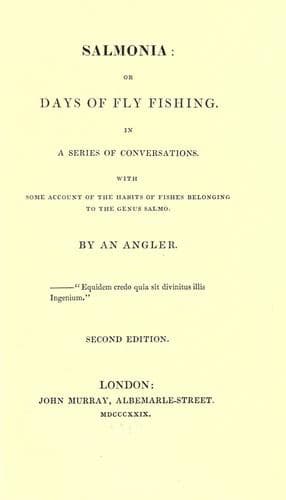
Salmonia; Or, Days of Fly Fishing: In a series of conversations. With some account of the habits of fishes belonging to the genus SalmoDavy, Humphry, Sir
Philosophy
Salmonia; Or, Days of Fly Fishing: In a series of conversations. With some account of the habits of fishes belonging to the genus Salmo
Davy, Humphry, Sir
Fishing
As instances of the difference in this respect between large and small
rivers, I may quote the Vockla and the Agger in Upper Austria. The first
of these rivers, when I fished in it in 1818, was full of trout and
grayling, and I believe I was the first person, for at least many years,
that had ever thrown an artificial fly upon it. It is a small stream,
from eight to fifteen yards wide, and can every where be commanded by
the double-handed rod, and is generally shallow. The first day that I
fished in this stream, which was in the beginning of August, at every
throw I hooked a fish, and I took out and restored again to their
element in the course of a few hours more than one hundred and fifty
trout and grayling. The next day I fished in the same places, but with a
very different result: I caught only half a dozen large fish: the third
morning, going over the same ground, I had great difficulty even to get
a brace of fish for my dinner, and those, as well as I recollect, I
caught by throwing in places which had not been fished before. I ought
to mention, that the space of water where this experiment was made did
not exceed half a mile in length. I shall now speak of the Agger, which
is a much larger and deeper river than the Vockla, and cannot be
commanded in any part by a double-handed rod, being at least from forty
to sixty yards across. The first time I fished this river, I had the
same kind of sport as in the Vockla; the second day, under the same
favourable circumstances, there were fewer rises than on the first day,
but still sufficient to give good sport; and it was the fourth day
before it became difficult to catch a good dish of fish, and necessary
to seek new water. The greater depth of the water, and the change of
place of the fish, particularly the grayling, explain this, to say
nothing of the greater number of fish which the larger river contained.
I am, of course, speaking of one of the best periods of fly-fishing,
when many large flies, of which imitations are easily found, have been
on the water. In spring (a bad season for fly-fishing in high Alpine
countries) I have thrown great varieties of flies on these two highly
stocked streams, and have found it difficult to get a brace of fish for
the table, as the trout and grayling were all lying at the bottom, not
expecting any _winged food_ at this season.
Public-domain text, read in full here on John Shaqi.
Reviews
Reviews
No reviews yet
Be the first to share your thoughts on this work.
Elsewhere in the archive
Join the Discussion
Join the discussion
Sign in to leave a comment or review.
Sign InorCreate an account