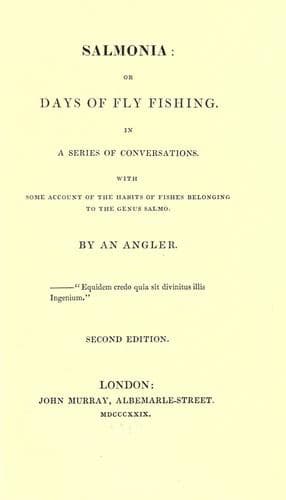
Salmonia; Or, Days of Fly Fishing: In a series of conversations. With some account of the habits of fishes belonging to the genus SalmoDavy, Humphry, Sir
Philosophy
Salmonia; Or, Days of Fly Fishing: In a series of conversations. With some account of the habits of fishes belonging to the genus Salmo
Davy, Humphry, Sir
Fishing
HAL.—I once went almost to the source of this river, above Rieti, in the
hopes of catching trout, but I was unsuccessful. I saw some taken by
nets, but the fish were too few, and the river too foul, from the
deposition of calcareous matter, to render it a good stream for the
angler. In this journey I saw some trout in brooks in the Sabine
country, that I dare say might have been taken by the fly, but they were
small, and like the brook trout of England. In these streams, as well as
in the Velino and other torrents, I found the water-ouzel, which, as far
as my knowledge extends, is always a companion of the trout, and I
believe feeds much upon the same larvæ or water-flies.
ORN.—These singular little birds, as I have witnessed, walk under water.
I have often watched them running beneath the surface of the sides of
streams, and passing between stones. I conclude they were then in the
act of searching for, or feeding upon larvæ.
HAL.—I suppose so, and I hope Ornither will shoot one to give us an
opportunity of examining the contents of their stomachs, and of knowing
with certainty the nature of their food.
PHYS.—The char[8] is a most beautiful and excellent fish, and is, of
course, a fish of prey. Is he not an object of sport to the angler?
HAL.—They generally haunt deep cool lakes, and are seldom found at the
surface till late in the autumn. When they are at the surface, however,
they will take either fly or minnow. I have known some caught in both
these ways; and have myself taken a char, even in summer, in one of
those beautiful, small, deep lakes in the Upper Tyrol, near Nazereit;
but it was where a cool stream entered from the mountain; and the fish
did not rise, but swallowed the artificial fly under water. The char is
always in its colour a very brilliant fish, but in different countries
there are many varieties in the tint. I do not remember ever to have
seen more beautiful fish than those of Aussee, which, when in perfect
season, have the lower fins and the belly of the brightest vermilion,
with a white line on the outside of the pectoral, ventral, anal, and
lower part of the caudal fin, and with vermilion spots, surrounded by
the bright olive shade of the sides and back: the dorsal fin in the char
has 11 spines, the pectoral 14, the ventral 9, the anal 10, and the
caudal 20. I have fished for them in many lakes, without success, both
in England and Scotland, and also amongst the Alps; and I am told the
only sure way of taking them is by sinking a line with a bullet, and a
hook having a live minnow attached to it, in the deep water which they
usually haunt; and in this way, likewise, I have no doubt the _umbla_,
or _ombre chevalier_, might be taken.
POIET.—I have never happened to see this fish.
Public-domain text, read in full here on John Shaqi.
Reviews
Reviews
No reviews yet
Be the first to share your thoughts on this work.
Elsewhere in the archive
Join the Discussion
Join the discussion
Sign in to leave a comment or review.
Sign InorCreate an account