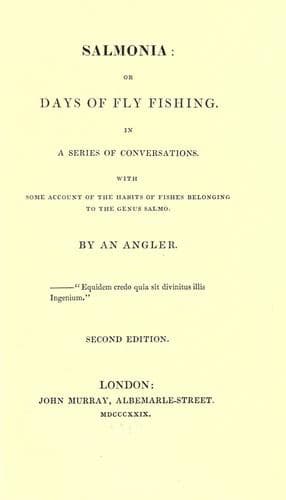
Salmonia; Or, Days of Fly Fishing: In a series of conversations. With some account of the habits of fishes belonging to the genus SalmoDavy, Humphry, Sir
Philosophy
Salmonia; Or, Days of Fly Fishing: In a series of conversations. With some account of the habits of fishes belonging to the genus Salmo
Davy, Humphry, Sir
Fishing
HAL.—It is very like char in form, but is without spots, and has a white
and silvery belly. On the table, its flesh cuts white or cream-colour,
and it is exceedingly like char in flavour. Feb. 11, 1827, one was
brought me from the lake of Bourget, in Savoy; it was said to be small
for this fish; it was 15 inches long, and 7½ in circumference. In the
dorsal fin there were 12 spines, in the pectoral 9, in the ventral 8, in
the anal 11, and in the caudal 24.
POIET.—Is it found in this country?
HAL.—From some descriptions I have heard of certain species of the salmo
found in the Maun See, Traun See, and Leopoldstadt See, I think it is.
Bloch says, that it is peculiar to the lakes of Geneva and Neufchatel;
but what I have just said must convince you of the inaccuracy of this
statement, as I dare say the fish exists in other deep waters of a like
character amongst the Alps. It is a fish closely allied to the char, and
congenerous both in form and habits.
PHYS.—You mentioned, among the fish for dinner, the laveret: I never
heard of this fish before.
HAL.—It is a fish known in England by the name of _shelley_, or fresh
water herring; in Wales, by that of _guinead_; in Ireland, by that of
_pollan_; and in Scotland, by that of _vengis_. In colour it is most
like a grayling, but with broader and larger scales: it is common in the
large lakes of most Alpine countries, and is known at Geneva by the name
of _ferra_; and I believe that the _salmo ceruleus_, or _wartmann_ of
Bloch, or the _gang-fisch_ of the lake of Constante, from a comparison
that I made of it with the _ferra_, is a variety of the same fish. It
sometimes is as large as 2lbs.; and when quite fresh, and well fried or
boiled, is an exceedingly good fish, and calvers like a grayling. The
laveret of different lakes has appeared to me to vary in the number of
the spines in the fins. One, brought me from the lake of Zurich, 13
inches long, and 8 inches in girth, had 12 spines in the dorsal fin, 15
in the pectoral fins, 11 in the ventral, 13 in the anal, and 18 in the
caudal. The gang-fisch, from the lake of Constanz, which was of a bluer
colour, but, I think decidedly, only a variety of the same fish, was 7¾
inches long, and 4 in girth, had 12 spines in the dorsal fin, 15 in the
pectoral, 11 in the ventral, 12 in the anal, and 18 in the caudal. A
laveret, from the Traun See, had 12 spines in the dorsal fin, 17 in the
pectoral, 13 in the ventral fin, 12 in the anal fin, and 24 in the
caudal fin. One from the Hallstadt See was a larger and broader fish,
but did not differ from the laveret, of the Traun See, except in having
two spines less in the tail.
POIET.—Is this fish ever taken with the line?
HAL.—I believe only with nets. It feeds on vegetables; and in the
stomachs of those I have opened, I have never found either flies or
small fishes.
AT TABLE.
Public-domain text, read in full here on John Shaqi.
Reviews
Reviews
No reviews yet
Be the first to share your thoughts on this work.
Elsewhere in the archive
Join the Discussion
Join the discussion
Sign in to leave a comment or review.
Sign InorCreate an account