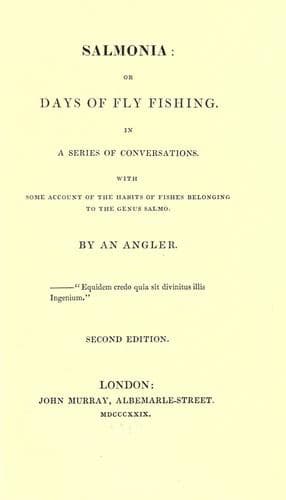
Salmonia; Or, Days of Fly Fishing: In a series of conversations. With some account of the habits of fishes belonging to the genus SalmoDavy, Humphry, Sir
Philosophy
Salmonia; Or, Days of Fly Fishing: In a series of conversations. With some account of the habits of fishes belonging to the genus Salmo
Davy, Humphry, Sir
Fishing
HAL.—The fly you see is called by fishermen the alder fly, and appears
generally in large quantities before the May-fly. Imitations of this
fly, and of the green and the gray drake of different shades, are the
only ones you will need this morning, though I doubt if the last can be
much used, as the gray drake is not yet on the water in any quantity.
PHYS.—Pray can you give us any account of these curious little animals?
HAL.—We ought to draw upon your stores of science for information on
these subjects.
PHYS.—I really know nothing of Entomology, but I am desirous of
acquiring knowledge.
HAL.—I have made few observations on flies as a philosophical
naturalist. What I know I will state at another time. But see, the green
drake is descending upon the water, and some are leaving the alders to
sport in the sunshine, and to enjoy the pleasures of their brilliant,
though short existence; and their life, naturally ephemeral, is made one
of scarcely a moment, by the fishes and birds: that which the swallow or
the duck spares is caught by the fish. The fly is new, and in the
imitation, I recommend the olive tint, or what the Irish call the green
monkey. That is, an artificial fly, with a wing of dyed yellow drake’s
feather, a body of yellow monkey’s fur, and a small quantity of olive
mohair for legs. For myself, I shall fish for some time with a large red
alder fly, and I dare say, with as much success. That is, with a fly
with a dark peacock’s harle for body, a red hackle for legs, and wings
of the land-rail below, and starling above.
POIET.—The water is quite in motion, what noble fish I see on the feed!
I never beheld a finer sight, though I have often seen the May-fly on
well-stocked waters.
HAL.—This river is most strictly preserved; not a fish has been killed
here since last August, and this is the moment when the large fish come
to the surface, and leave their cad bait search and minnow hunting. But
I have hardly time to talk; I have hold of a good fish: they take either
alder or May-fly, and having never been fished for this year, they make
no distinction, and greedily seize any small object in motion on the
water. You see the alder-fly is quite as successful as the May-fly; but
there is a fish which has refused it, and because he has been feeding,
glutton-like, on the May-fly: that is the fifth he has swallowed in a
minute. Now I shall throw the drake a foot above him. It floats down,
and he has taken it. A fine fish; I think at least 4lbs. This is the
largest fish we have yet seen, but in the deep water still lower down,
there are still greater fish. One of 5lbs. I have known taken here, and
once a fish a little short only of 6lbs.
POIET.—I have just landed a fish which I suppose you will consider as a
small one; yet I am tempted to kill him.
Public-domain text, read in full here on John Shaqi.
Reviews
Reviews
No reviews yet
Be the first to share your thoughts on this work.
Join the Discussion
Join the discussion
Sign in to leave a comment or review.
Sign InorCreate an account