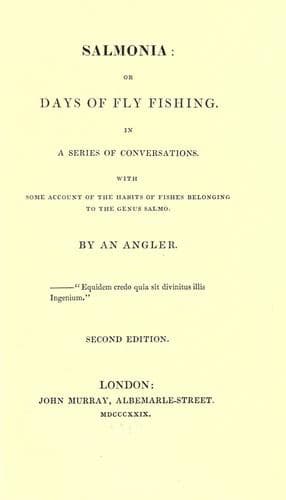
Salmonia; Or, Days of Fly Fishing: In a series of conversations. With some account of the habits of fishes belonging to the genus SalmoDavy, Humphry, Sir
Philosophy
Salmonia; Or, Days of Fly Fishing: In a series of conversations. With some account of the habits of fishes belonging to the genus Salmo
Davy, Humphry, Sir
Fishing
dyed of the deepest azure, and retains partially this colour till it is
joined by the Soane, which gives to it a greener hue. The Lake of Morat,
on the contrary, which is fed from a lower country, and from less pure
sources, is grass green. And there is an illustrative instance in some
small lakes fed from the same source, in the road from Inspruck to
Stutgard, which I observed in 1815 (as well as I recollect) between
Nazareit and Reiti. The highest lake fed by melted snows in March, when
I saw it, was bright blue. It discharged itself by a small stream into
another, into which a number of large pines had been blown by a winter
storm, or fallen from some other cause: in this lake its colour was blue
green. In a third lake, in which there were not only pines and their
branches, but likewise other decaying vegetable matter, it had a tint of
faded grass green; and these changes had occurred in a space not much
more than a mile in length. These observations I made in 1815: on
returning to the same spot twelve years after, in August and September,
I found the character of the lakes entirely changed. The pine wood
washed into the second lake had disappeared; a large quantity of stones
and gravel, washed down by torrents, or detached by an avalanche,
supplied their place: there was no perceptible difference of tint in the
two upper lakes; but the lower one, where there was still some vegetable
matter, seemed to possess a greener hue. The same principle will apply
to the Scotch and Irish rivers, which, when they rise or issue from pure
rocky sources, are blue, or bluish green; and when fed from peat bogs,
or alluvial countries, yellow, or amber-coloured, or brown—even after
they have deposited a part of their impurities in great lakes.
Sometimes, though rarely, mineral impregnations give colour to water:
small streams are sometimes green or yellow from ferruginous
depositions. Calcareous matters seldom affect their colour, but often
their transparency, when deposited, as is the case with the Velino at
Terni, and the Anio at Trivoli; but I doubt if pure saline matters,
which are in themselves white, ever change the tint of water.
ORN.—On what then does the tint of the ocean depend, which has itself
given name to a colour?
Public-domain text, read in full here on John Shaqi.
Reviews
Reviews
No reviews yet
Be the first to share your thoughts on this work.
Elsewhere in the archive
Join the Discussion
Join the discussion
Sign in to leave a comment or review.
Sign InorCreate an account