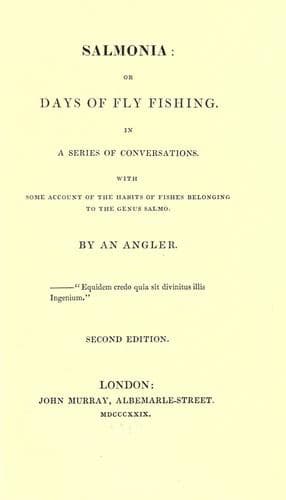
Salmonia; Or, Days of Fly Fishing: In a series of conversations. With some account of the habits of fishes belonging to the genus SalmoDavy, Humphry, Sir
Philosophy
Salmonia; Or, Days of Fly Fishing: In a series of conversations. With some account of the habits of fishes belonging to the genus Salmo
Davy, Humphry, Sir
Fishing
POIET.—You, Halieus, must certainly have considered the _causes_ which
produce the colours of waters. The streams of our own island are of a
very different colour from these mountain rivers, and why should the
same element or substance assume such a variety of tints?
HAL.—I certainly have often thought upon the subject, and I have made
some observations and _one_ experiment in relation to it. I will give
you my opinion with pleasure, and, as far as I know, they have not been
brought forward in any of the works on the properties of water, or on
its consideration as a chemical element. The purest water with which we
are acquainted is undoubtedly that which falls from the atmosphere.
Having touched air alone, it can contain nothing but what it gains from
the atmosphere, and it is distilled without the chance of those
impurities, which may exist in the vessels used in an artificial
operation. We cannot well examine the water precipitated from the
atmosphere, as rain, without collecting it in vessels, and all
artificial contact gives more or less of contamination; but in snow,
melted by the sunbeams, that has fallen on glaciers, themselves formed
from frozen snow, water may be regarded as in its state of greatest
purity. Congelation expels both salts and air from water, whether
existing below, or formed in, the atmosphere; and in the high and
uninhabited regions of glaciers, there can scarcely be any substances to
contaminate. Removed from animal and vegetable life, they are even above
the mineral kingdom; and though there are instances in which the rudest
kind of vegetation (of the fungus or mucor kind) is even found upon
snows, yet this is a rare occurrence; and red snow, which is occasioned
by it, is an extraordinary and not a common phenomenon towards the pole,
and on the highest mountains of the globe. Having examined the water
formed from melted snow on glaciers in different parts of the Alps, and
having always found it of the same quality, I shall consider it as pure
water, and describe its characters. Its colour, when it has any depth,
or when a mass of it is seen through, is bright blue; and, according to
its greater or less depth of substance, it has more or less of this
colour: as its insipidity, and its other physical qualities, are not at
this moment objects of your inquiry, I shall not dwell upon them. In
general, in examining lakes and masses of water in high mountains, their
colour is of the same bright azure. And Captain Parry states, that the
water on the Polar ice has the like beautiful tint. When vegetables grow
in lakes, the colour becomes nearer the sea green, and as the quantity
of impregnation from their decay increases—greener, yellowish green, and
at length, when the vegetable extract is large in quantity—as in
countries where peat is found—yellow, and even brown. To mention
instances, the Lake of Geneva, fed from sources (particularly the higher
Rhone) formed from melting snow, is blue; and the Rhone pours from it,
Public-domain text, read in full here on John Shaqi.
Reviews
Reviews
No reviews yet
Be the first to share your thoughts on this work.
Elsewhere in the archive
Join the Discussion
Join the discussion
Sign in to leave a comment or review.
Sign InorCreate an account