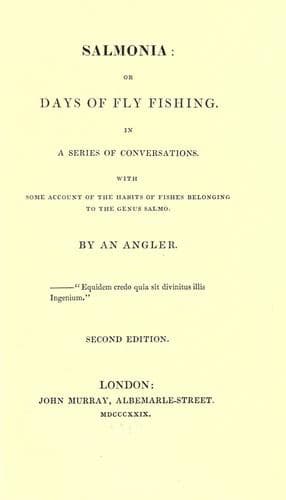
Salmonia; Or, Days of Fly Fishing: In a series of conversations. With some account of the habits of fishes belonging to the genus SalmoDavy, Humphry, Sir
Philosophy
Salmonia; Or, Days of Fly Fishing: In a series of conversations. With some account of the habits of fishes belonging to the genus Salmo
Davy, Humphry, Sir
Fishing
HAL.—But our horses are ready, and the time of separation arrives. I
trust we shall all have a happy meeting in England in the winter. I have
made you idlers at home and abroad, but I hope to some purpose; and, I
trust, you will confess the time bestowed upon angling has not been
thrown away. The most important principle perhaps in life is to have a
pursuit—a useful one if possible, and at all events an innocent one. And
the scenes you have enjoyed—the contemplations to which they have led,
and the exercise in which we have indulged, have, I am sure, been very
salutary to the body, and, I hope, to the mind. I have always found a
peculiar effect from this kind of life; it has appeared to bring me back
to early times and feelings, and to create again the hopes and happiness
of youthful days.
PHYS.—I felt something like what you described, and were I convinced
that in the cultivation of the amusement, these feelings would increase,
I would devote myself to it with passion; but, I fear, in my case this
is impossible. Ah! could I recover any thing like that freshness of
mind, which I possessed at twenty-five, and which, like the dew of the
dawning morning, covered all objects and nourished all things that grew,
and in which they were more beautiful even than in mid-day
sunshine,—what would I not give!—All that I have gained in an active and
not unprofitable life. How well I remember that delightful season, when,
full of power, I sought for power in others; and power was sympathy, and
sympathy power;—when the dead and the unknown, the great of other ages
and of distant places, were made, by the force of the imagination, my
companions and friends;—when every voice seemed one of praise and love;
when every flower had the bloom and odour of the rose; and every spray
or plant seemed either the poet’s laurel, or the civic oak—which
appeared to offer themselves as wreaths to adorn my throbbing brow. But,
alas! this cannot be; and even you cannot have _two springs_ in
life—though I have no doubt you have fishing days, in which the feelings
of youth return, and that your autumn has a more _vernal_ character than
mine.
POIET.—I do not think Halieus had ever any season, except a perpetual
and gentle spring; for the tones of his mind have been always so quiet,
it has been so little scorched by sunshine, and so little shaken by
winds, that, I think, it may be compared to that sempivernal climate
fabled of the Hesperides, where the same trees produced at once buds,
leaves, blossoms, and fruits.
Public-domain text, read in full here on John Shaqi.
Reviews
Reviews
No reviews yet
Be the first to share your thoughts on this work.
Elsewhere in the archive
Join the Discussion
Join the discussion
Sign in to leave a comment or review.
Sign InorCreate an account