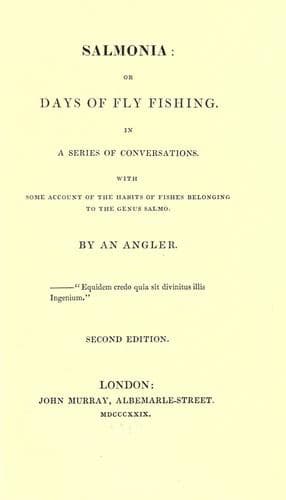
Salmonia; Or, Days of Fly Fishing: In a series of conversations. With some account of the habits of fishes belonging to the genus SalmoDavy, Humphry, Sir
Philosophy
Salmonia; Or, Days of Fly Fishing: In a series of conversations. With some account of the habits of fishes belonging to the genus Salmo
Davy, Humphry, Sir
Fishing
HAL.—Nay, my friends! spare me a little, spare my gray hairs. I have not
perhaps abused my youth so much as some of my friends, but all things
that you have known, I have known; and if I have not been so much
scorched by the passions from which so many of my acquaintances have
suffered, I owe it rather to the constant employment of a laborious
profession, and to the exertions called for by the hopes, wants, and
wishes of a rising family, than to any merits of my own, either moral or
constitutional. For my health, I may thank my ancestors, after my God,
and I have not squandered what was so bountifully given; and though I do
not expect, like our arch-patriarch, Walton, to number ninety years and
upwards, yet, I hope, as long as I can enjoy in a vernal day the warmth
and light of the sunbeams, still to haunt the streams—following the
example of our late venerable friend, the President of the Royal
academy,[9] in company with whom, when he was an octogenarian, I have
thrown the fly, caught trout, and enjoyed a delightful day of angling
and social amusement, in the shady green meadows by the bright clear
streams of the Wandle.
ADDITIONAL NOTES.
(_On the par, page 75._)
The author, in supposing that the par may be produced from a cross
between the river trout and the sea trout, does not mean to attach any
importance to this idea. The fish differs so little from the common
trout, that it may be questioned, whether it is not more entitled to the
character of a variety than of a species. In many rivers on the
continent, the author has seen small trout with olive or brown marks,
like those of the British par; and a friend informs him, that he has
caught fish of the same kind in the streams connected with the Lake of
Geneva. In rivers, flowing into the Danube, these small fish are very
common; but, as well as he remembers, their marks are pale, or
yellowish-brown, or olive, and not dark or blue like those of our par.
The salmon does not belong to any of these localities, but the hucho
haunts the tributary streams of the Danube. The smelts, or young of the
salmo hucho, and sea trout, and lake trout, are all distinguished by the
_uniform_ dark colour of the back, and the silvery whiteness of the
belly. He does not remember to have seen any of the streaked, or par
varieties of trout in rivers, in which there was only _one_ species, or
variety of large salmo. The mottled colour of the skin is, he thinks,
the strongest argument in favour of this little fish, being from a cross
of two varieties, or races, which may be the case, and yet the fish be
capable of breeding, and gaining this character of a peculiar variety;
and he supposes different kinds of pars may be produced by crosses of
the sea trout, the hucho, the lake trout, with the river trouts, or
perhaps of the salmon, and this would account for their great numbers,
and the various tints of the marks on their _sides_. If the hucho, as he
Public-domain text, read in full here on John Shaqi.
Reviews
Reviews
No reviews yet
Be the first to share your thoughts on this work.
Elsewhere in the archive
Join the Discussion
Join the discussion
Sign in to leave a comment or review.
Sign InorCreate an account