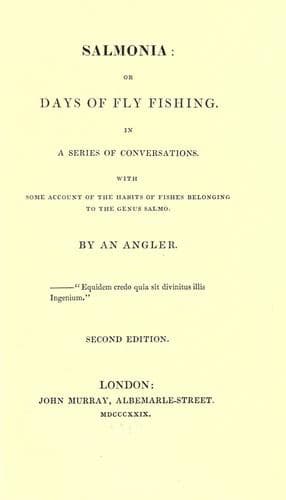
Salmonia; Or, Days of Fly Fishing: In a series of conversations. With some account of the habits of fishes belonging to the genus SalmoDavy, Humphry, Sir
Philosophy
Salmonia; Or, Days of Fly Fishing: In a series of conversations. With some account of the habits of fishes belonging to the genus Salmo
Davy, Humphry, Sir
Fishing
As this bird is rarely seen in England, I shall mention its
peculiarities. It is more than one-third larger than the common snipe,
and has a breast spotted with gray feathers. Its beak is shorter than
that of the snipe; the old ones have feathers almost pure white in
their tails, and as they spread them when rising, they are easily
distinguished by this character from the snipe; but in the young birds
that I have seen in August, this character was wanting. They are
usually very fat, particularly the young birds; their weight varies
from six to nine ounces; but even the fattest ones are rarely above
seven ounces and a half; and though I have killed more than a hundred,
I can speak of half-a-dozen only that weighed above eight ounces and a
half. In spring they are usually found in pairs, the female being
rather larger, and having a paler breast: in autumn they are solitary.
They prefer wet meadows to bogs, or large, deep marshes. They usually
lie closer than snipes, and seldom fly far. Their flight is straight,
like that of a jack snipe, and they are easily shot.
Attention to the migrations of birds might, I have no doubt, lead to
important indications respecting the character and changes of the
weather and the seasons. The late migration of the solitary snipe this
year (1828) seems to have been an indication of a wet and backward
summer in the north of Europe. But to form opinions upon facts of this
kind requires much knowledge and caution. The perfection of the larvæ
of the tibulæ on which this snipe feeds depends upon a number of
circumstances: the temperature of the last year; the period when the
eggs were laid; the heat of the water when they were deposited, and
the quantity of rain since. The migration of the solitary snipe is
only one link in a great chain of causes and effects, all connected,
and extending from Africa to Siberia.
Footnote 6:
_Lax_ is the Teutonic word for salmon.
Footnote 7:
I may mention one remarkable instance as an exception, which has
recently occurred to me, the 21st of May, 1828. I was fishing in the
Save, between Wochain and Veldes, in some deep, clear, bright, green
pools. I caught five or six grayling between 15 and 17 inches long,
that had all leeches near the tail; they were beautifully coloured,
and had probably got these parasitic animals after their spawning,
when they reposed. Of course this was the time when they were in their
worst season, as they were just beginning to recover from the work of
generation. At this time they often rose at and refused the fly, but
there were as yet no large flies on the water. The leech was a small
greenish dark worm, about an inch or an inch and a half long, like a
common leech in form and colour.
Footnote 8:
Sälmling of the Germans.
Footnote 9:
Benjamin West.
Transcriber’s Notes
Public-domain text, read in full here on John Shaqi.
Reviews
Reviews
No reviews yet
Be the first to share your thoughts on this work.
Elsewhere in the archive
Join the Discussion
Join the discussion
Sign in to leave a comment or review.
Sign InorCreate an account