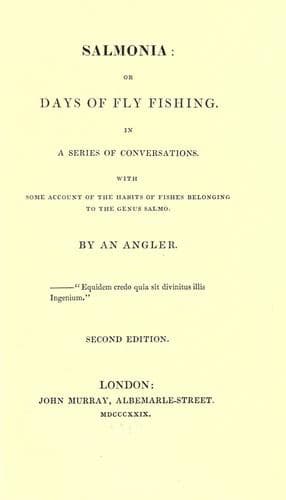
Salmonia; Or, Days of Fly Fishing: In a series of conversations. With some account of the habits of fishes belonging to the genus SalmoDavy, Humphry, Sir
Philosophy
Salmonia; Or, Days of Fly Fishing: In a series of conversations. With some account of the habits of fishes belonging to the genus Salmo
Davy, Humphry, Sir
Fishing
I have known the number of spines in the pectoral fins different, in
different varieties of trout; I have seen them 12, 13, and 14: but the
anal fin always, I believe, contains 11 spines, the dorsal 12 or 13,
the ventral 9, and the caudal 21. The smallest brook trout, when well
and copiously fed, will increase in stews to four or five pounds in
weight, but never attains the size or characters of lake trout.
Mr. Tonkin of Polgaron put some small river trout, 2½ inches in
length, into a newly-made pond. He took some of these out the second
year, and they were above 12 inches in length; the third year, he took
one out that was 16 inches; and the fourth year, one of 25 inches:
this was in 1734. (_Carew’s Survey of Cornwall_, p. 87. Lord de
Dunstanville’s edition.)
Footnote 5:
From the food, and the remains of food, found in the stomach of the
double snipe, I think I have ascertained, that it requires a kind of
worm, which is not found in winter even in the temperate climes of
Europe; and that it feeds differently from the snipe. There are
certainly none found after the end of October in either Illyria or
Italy; and I believe the same may be said of the end of May, as to
their summer migration, or their breeding migration. I have opened the
stomachs of at least a dozen of these birds, and their contents were
always of the same kind, long slender white hexapode larvæ, or their
skins, of different sizes, from that of the maggot of the horse-fly to
one thrice as long. I believe all these insects were the larvæ of
tibulæ of different species. In the stomach of the common snipe, which
is stronger and larger, I have generally found earth-worms, and often
seeds, and rice, and gravel. I conjecture, that, in the temperate
climates of Europe, most of the aquatic larvæ on which the solitary
snipe feeds are converted into flies in the late spring and autumn,
which probably limits the period of their migration. In 1827 the
solitary snipe passed through Italy and Illyria between the 15th of
March and the 6th of May. I heard of the first at Ravenna the 17th of
March, and I shot two near Laybach on the 5th of May; but though I was
continually searching for them for a fortnight after, I found no more.
This year they returned from the north early; and I saw some in the
marshes of Illyria on the 19th of August. In 1828 they were later in
their vernal passage, and likewise in their return. I found them in
Illyria through May, as late as the 17th, on which day I shot three,
and they did not re-appear till the beginning of September. I found
one on the 3d, and three on the 4th, and twenty were shot on the 7th.
Public-domain text, read in full here on John Shaqi.
Reviews
Reviews
No reviews yet
Be the first to share your thoughts on this work.
Elsewhere in the archive
Join the Discussion
Join the discussion
Sign in to leave a comment or review.
Sign InorCreate an account