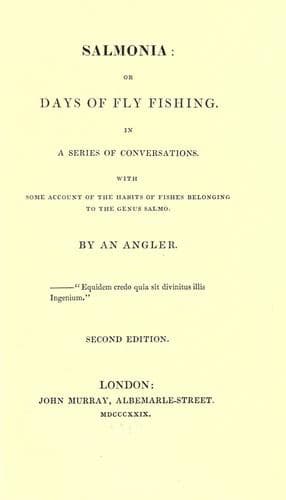
Salmonia; Or, Days of Fly Fishing: In a series of conversations. With some account of the habits of fishes belonging to the genus SalmoDavy, Humphry, Sir
Philosophy
Salmonia; Or, Days of Fly Fishing: In a series of conversations. With some account of the habits of fishes belonging to the genus Salmo
Davy, Humphry, Sir
Fishing
POIET.—He has hardly any spots, and is silvery all over; and the whole
of the lower part of his body is beautifully clean.
HAL.—He is likewise broad-backed; and you may observe his few spots are
black, and these are very small. I have always remarked, in this river,
that the nearer the fish approach to perfection, the colour of the body
becomes more uniform,—pale olive above, and bright silver below; and
these qualities are always connected with a small head,—or rather, an
oval body, and deep-red flesh.
POIET.—May not the red spots be marks of disease—a hectic kind of
beauty? For I observed in a very thin and poor fish, and great-headed,
that I caught an hour ago, which had leeches sticking to it, a number of
red spots, and a long black back, and black or bluish marks even on the
belly.
HAL.—I do not think red spots a symptom of disease; for I have seen fish
in other rivers, and even small fish in this river, in perfectly good
season, with red spots; but the colours of fish are very capricious, and
depend upon causes which cannot be easily defined. The colouring matter
is not in the scales, but in the surface of the skin immediately beneath
them, and is probably a secretion easily affected by the health of the
animal. I have known fish, from some lakes in Ireland, mottled in a most
singular way,—their colour being like that of the tortoise: the nature
of the water, exposure to the light, and probably the kind of food,
produce these effects. I think it possible, when trout feed much on hard
substances, such as larvæ and their cases, and the ova of other fish,
they have more red spots, and redder fins. This is the case with the
gillaroo and the char, who feed on analogous substances: and the trout,
that have similar habits, might be expected to resemble them. When trout
feed most on small fish, as minnows, and on flies, they have more
tendency to become spotted with small black spots, and are generally
more silvery. The Colne trout are, in their advanced state, of this
kind; and so are the trout called in Ireland buddocks and dolochans,
found in Loch Neah. Particular character becomes hereditary, and the
effects of a peculiar food influence the appearance of the next
generation. I hope, Ornither, you have had good sport.
ORN.—Excellent! Since you left me, below the wear, I have hooked at
least fifteen or twenty good fish, and landed and saved eight above
2lbs.; but I have taken no fish like the great one which I caught by
poaching with the natural flies. The trout rose wonderfully well within
the last quarter of an hour, but they are now all still; and the river,
which was in such active motion, is now perfectly quiet, and seems
asleep and almost dead.
Public-domain text, read in full here on John Shaqi.
Reviews
Reviews
No reviews yet
Be the first to share your thoughts on this work.
Join the Discussion
Join the discussion
Sign in to leave a comment or review.
Sign InorCreate an account