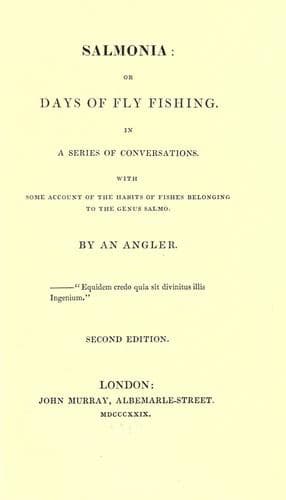
Salmonia; Or, Days of Fly Fishing: In a series of conversations. With some account of the habits of fishes belonging to the genus Salmo — John Shaqi
Salmonia; Or, Days of Fly Fishing: In a series of conversations. With some account of the habits of fishes belonging to the genus SalmoDavy, Humphry, Sir
Philosophy
Salmonia; Or, Days of Fly Fishing: In a series of conversations. With some account of the habits of fishes belonging to the genus Salmo
Davy, Humphry, Sir
Fishing
POIET.—We have at least passed over half-a-mile of water, and have seen
no fish rise; yet there is a yellowish or reddish fly in the air, which
moves like a drake; and there are clouds of pale brown flies encircling
the alders. Now I think I see a large trout rise below that alder.
HAL.—That is not a trout, for he rises in a different place now, and is
probably a large roach or chub; do not waste your time upon him. You may
always know a large trout when feeding in the evening. He rises
continuously, or at small intervals,—in a still water almost always in
the same place,—and makes little noise,—barely elevating his mouth to
suck in the fly, and sometimes showing his back-fin and tail. A large
circle spreads around him, but there are seldom many bubbles when he
breaks the water, which usually indicate the coarser fish: we will wait
a few minutes; I know there must be trout here, and the sun is setting,
and the yellow fly, or dun cut, coming on the water. See, beneath that
alder is a trout rising, and now there is another thirty yards higher
up. Take care, get your line out in another part of the water, and in
order, for reaching the fish, and do not throw till you are sure you can
reach the spot, and throw at least half-a-yard above the fish.
ORN.—He rose, I suppose, at a natural fly, the moment before my fly
touched the water.
HAL.—Try again. You have hooked him, and you have done well not to
strike when he rose. Now hold him tight, wind up your line, and carry
him down the stream. Push the boat down stream, fisherman. Keep your
fish’s head up. He begins to tire,—and there is landed. A fine well-fed
fish, not much less than 4lbs. Throw him into the well. Now, Poietes,
try that fish rising above,—and there are two more.
POIET.—I have him!
HAL.—Take care. He has turned you, and you have suffered him to run out
your line, and he is gone into the weeds under the willow: let him fall
down stream.
POIET.—I cannot get him out.
HAL.—Then wind up. I fear he is lost, yet we will try to recover him by
taking the boat up. The line is loose: he has left the link entangled in
the weeds, and carried your fly with him. He must have been a large
fish, or he could not have disentangled himself from so strong a gut.
Try again, there are fish now rising above and below; where the water is
in motion, opposite that willow, there are two fish rising.
POIET.—I have one of them.
HAL.—Now you are doing well. Down with the boat, and drag your fish
downwards. Continue to do so, as there are weeds all round you. You can
master him now; keep him high, and he is your own. Put the net under
him, and bring him into the boat; he is a well-fed fish, but not of the
proper size for a victim: about 2lbs. Now, Physicus, try your fortune
with the fish above that rises so merrily still. You have him! Now use
him as Poietes did the last. Very well; I see he is a large fish,—take
your time. He is landed; a fish nearly of 3lbs., and in excellent
season.
Public-domain text, read in full here on John Shaqi.
Reviews
Reviews
No reviews yet
Be the first to share your thoughts on this work.
Join the Discussion
Join the discussion
Sign in to leave a comment or review.
Sign InorCreate an account