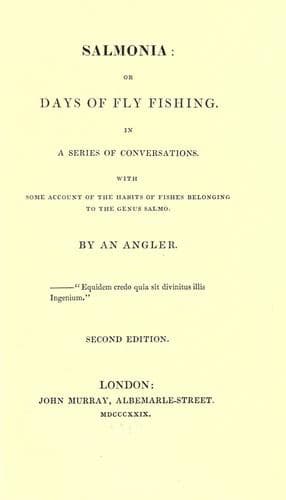
Salmonia; Or, Days of Fly Fishing: In a series of conversations. With some account of the habits of fishes belonging to the genus SalmoDavy, Humphry, Sir
Philosophy
Salmonia; Or, Days of Fly Fishing: In a series of conversations. With some account of the habits of fishes belonging to the genus Salmo
Davy, Humphry, Sir
Fishing
might be said, that trout, after having thickened their stomachs by
feeding on larvæ with hard cases, gained the power of eating shell-fish,
and were gradually changed to gillaroos and to char; their red spots and
the yellow colour of their belly and fins increasing. In the same manner
it might be said, that the large trout which feed almost entirely on
small fishes, gained more spines in the pectoral fins, and became a new
species; but _I_ shall not go so far, and I know no facts of this kind.
The gillaroo and the char appear always with the same characters: and I
have never seen any fish that seemed in a state of transition from a
trout to gillaroo or a char; which I think, must have been the case if
such changes took place. I hope, after this explanation, Physicus will
not find any analogy between my ideas and those of a school, to which I
am not ambitious of being thought to belong; and that he will allow my
views to be sound, or at least founded upon correct analogies.
POIET.—Do you know any facts of a similar kind in confirmation of your
idea that the par is a mule?
HAL.—I have heard of similar instances, but I cannot say I have myself
witnessed them. The common carp and the cruscian are said to produce a
mixed race, and likewise the rud and the roach; but I have never paid
much attention to varieties of the carp kind. A friend of mine informed
me, that in a branch of the Test, into which graylings had recently been
introduced, his fisherman caught a fish, which appeared to be from a
cross between the trout and grayling, having the high back fin of the
grayling, and the head and spots of the trout: this is the more
remarkable, if correct, as the grayling spawns in the late spring, and
the trout in the late autumn or winter: yet I _do_ recollect that I once
took a grayling in the end of November, in which the ova were so large,
as nearly to be ready for protrusion. The fisherman of the Gründtl See,
in Styria, informed me, that he had seen a fish which he believed to be
a mule between the trout and char, the fins of which resembled those of
a trout, though the body was in other respects like that of a char. The
seasons at which these two species spawn approach nearer to each other;
but the char spawns in still and the trout in running water. In general
the trout are mature before the char, yet I have seen in the
Leopoldstein See, in Styria, a female char, of which the eggs were
almost fully developed as early as June: the fisherman of the Gründtl
See said, that these peculiar fish were very rare, and that he caught
only one in about 500 char. It is not, I think, impossible, that it may
be an umbla, a fish that might be expected to be found in that deep,
cold, Alpine lake, a peculiar species and not a mixed variety. It is a
fertile and very curious subject for new experiments, that of crossing
the breeds of fishes, and offers a very interesting and untouched field
of investigation, which I hope will soon be taken up by some enlightened
Public-domain text, read in full here on John Shaqi.
Reviews
Reviews
No reviews yet
Be the first to share your thoughts on this work.
Join the Discussion
Join the discussion
Sign in to leave a comment or review.
Sign InorCreate an account