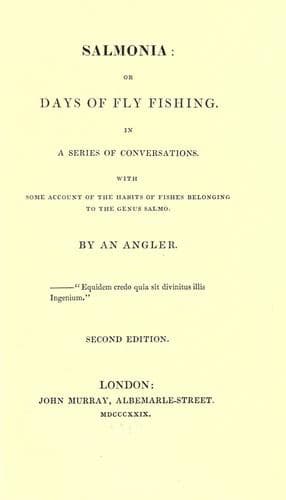
Salmonia; Or, Days of Fly Fishing: In a series of conversations. With some account of the habits of fishes belonging to the genus SalmoDavy, Humphry, Sir
Philosophy
Salmonia; Or, Days of Fly Fishing: In a series of conversations. With some account of the habits of fishes belonging to the genus Salmo
Davy, Humphry, Sir
Fishing
But in all experiments of this kind, the
great principle is, to have a constant current of fresh and aerated
water running over the eggs. The uniform supply of air to the fœtus in
the egg is essential for its life and growth, and such eggs as are not
supplied with water saturated with air are unproductive. The
experimenter must be guided exactly by the instinct of the parent
fishes, who take care to deposit the impregnated eggs, that are to
produce their offspring, only in sources continually abounding in fresh
and aerated water.
PHYS.—But as every species of fish has a particular and usually
different time for spawning, I do not see how it could be contrived to
cross their breeds, or how the ova of a trout, which spawns in December,
could be impregnated by the seminal fluid of the grayling, which spawns
in May; for I conclude it would be impossible to preserve the eggs of a
fish out of the body in a state in which they could retain or recover
their vitality.
HAL.—I believe I mentioned before, that I had found instances, in which
the ova of fish were developed at a different period from their natural
one; and I have no doubt, that a little inquiry respecting the habits of
fishes would enable us to acquire a knowledge of the circumstances,
which either hasten or retard their maturity. Plenty of food and a
genial season hasten the period of their reproduction, which is delayed
by want of proper nourishment, and by unfavourable weather. Males and
females likewise, confined from each other, have their generative powers
impeded; and trout, grayling, and salmon, will not deposit their ova
except in running water; so that by keeping them in tanks, the period of
their maturity might be considerably altered. I have seen char even,
which had been kept in confined water from September till July; and so
slow had been the progress of the ova, that they appeared to be about
this time fit for exclusion, though, in the natural course of things,
they would have been ripe in the end of October of the year before. By
attending to and controlling all these circumstances, I have no doubt
many interesting experiments might be made, as to the possibility of
modifying the varieties of the salmo, by impregnating the ova of one
species with the seminal fluid of another. With fishes of other genera
the task would be still more easy. Carp, perch, and pike, deposit their
ova in still water in spring and summer, when it is supplied with air by
the growth of vegetables: and it is to the leaves of plants, which
afford a continual supply of oxygen to the water, that the impregnated
eggs usually adhere; so that researches of this kind might be conducted
within doors in close vessels, filled with plants, exposed to the sun. I
have myself kept minnows and sticklebacks alive for many months in the
same confined quantity of water, containing a few confervæ; and their
ova and melt increased in the same manner, as if they had been in their
natural situation.
Public-domain text, read in full here on John Shaqi.
Reviews
Reviews
No reviews yet
Be the first to share your thoughts on this work.
Join the Discussion
Join the discussion
Sign in to leave a comment or review.
Sign InorCreate an account