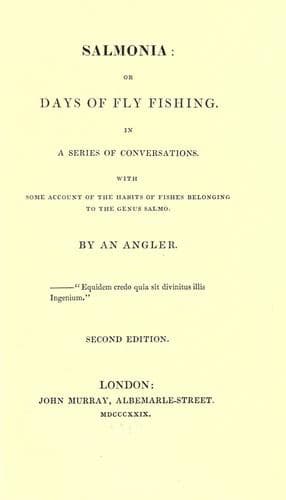
Salmonia; Or, Days of Fly Fishing: In a series of conversations. With some account of the habits of fishes belonging to the genus SalmoDavy, Humphry, Sir
Philosophy
Salmonia; Or, Days of Fly Fishing: In a series of conversations. With some account of the habits of fishes belonging to the genus Salmo
Davy, Humphry, Sir
Fishing
HALIEUS—POIETES—PHYSICUS—ORNITHER.
INTRODUCTORY CONVERSATION—SYMPOSIAC.
_Scene, London._
PHYS.—HALIEUS, I dare say you know where this excellent trout was
caught: I never ate a better fish of the kind.
HAL.—I ought to know, as it was this morning in the waters of the
Wandle, not ten miles from the place where we sit, and it is through my
means that you see it at table.
PHYS.—Of your own catching?
HAL.—Yes, with the artificial fly.
PHYS.—I admire the fish, but I cannot admire the art by which it was
taken; and I wonder how a man of your active mind and enthusiastic
character can enjoy what appears to me a stupid and melancholy
occupation.
HAL.—I might as well wonder in my turn, that a man of your discursive
imagination and disposition to contemplation should not admire this
occupation, and that you should venture to call it either stupid or
melancholy.
PHYS.—I have at least the authority of a great moralist, Johnson, for
its folly.
HAL.—I will allow no man, however great a philosopher, or moralist, to
abuse an occupation he has not tried; and as well as I remember, this
same illustrious person praised the book and the character of the great
Patriarch of Anglers, Isaac Walton.
PHYS.—There is another celebrated man, however, who has abused this your
patriarch, Lord Byron, and that in terms not very qualified. He calls
him, as well as I can recollect, “A quaint old cruel coxcomb.”[1] I must
say, a practice of this great fisherman, where he recommends you to pass
the hook through the body of a frog with care, as though you loved him,
in order to keep him alive longer, cannot but be considered as cruel.
HAL.—I do not justify either the expression or the practice of Walton in
this instance; but remember, _I_ fish only with inanimate baits, or
imitations of them, and I will not exhume or expose the ashes of the
dead, nor vindicate the memory of Walton, at the expense of Byron, who,
like Johnson, was no fisherman: but the moral and religious habits of
Walton, his simplicity of manners, and his well-spent life, exonerate
him from the charge of cruelty; and the book of a coxcomb would not have
been so great a favourite with most persons of refined taste. A noble
lady, long distinguished at court for pre-eminent beauty and grace, and
whose mind possesses undying charms, has written some lines in my copy
of Walton, which, if you will allow me, I will repeat to you.
Albeit, gentle Angler, I
Delight not in thy trade,
Yet in thy pages there doth lie
So much of quaint simplicity,
So much of mind,
Of such good kind,
That none need be afraid,
Caught by thy cunning bait, this book,
To be ensnared on thy hook.
Public-domain text, read in full here on John Shaqi.
Reviews
Reviews
No reviews yet
Be the first to share your thoughts on this work.
Join the Discussion
Join the discussion
Sign in to leave a comment or review.
Sign InorCreate an account