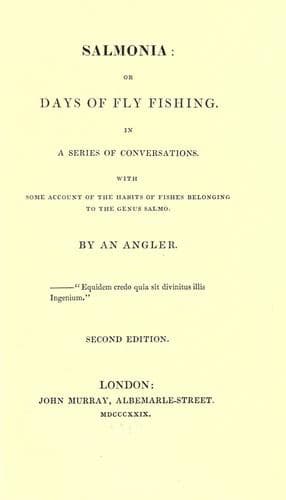
Salmonia; Or, Days of Fly Fishing: In a series of conversations. With some account of the habits of fishes belonging to the genus SalmoDavy, Humphry, Sir
Philosophy
Salmonia; Or, Days of Fly Fishing: In a series of conversations. With some account of the habits of fishes belonging to the genus Salmo
Davy, Humphry, Sir
Fishing
PHYS.—It appears to me that so powerful a fish ought to have struggled
much longer: yet, without great exertions on your part, in ten minutes
he appeared quite exhausted, and lay on his side as if dying: this
induces me to suppose, that there must be some truth in the vulgar
opinion of anglers, that fish are, as it were, drowned by the play of
the rod and reel.
HAL.—The vulgar opinion of anglers on this subject I believe to be
perfectly correct: though, to apply the word drowning to an animal that
lives in the water is not quite a fit use of language. Fish, as you
ought to know, respire by passing water, which always holds common air
in solution, through their gills or bronchial membrane, by the use of a
system of muscles surrounding the fauces, which occasion constant
contractions and expansions, or openings and closings of this membrane,
and the life of the fish is dependant on the process in the same manner
as that of a quadruped is on inspiring and expiring air. When a fish is
hooked in the upper part of the mouth by the strength of the rod applied
as a lever to the line, it is scarcely possible for him to open the
gills as long as this force is exerted, particularly when he is moving
in a rapid stream; and when he is hooked in the lower jaw, his mouth is
kept closed by the same application of the strength of the rod, so that
no aerated water can be inspired. Under these circumstances he is
quickly deprived of his vital forces, particularly when he exhausts his
strength by moving in a rapid stream. A fish, hooked in a part of the
mouth where the force of the rod will render his efforts to respire
unavailing, is much in the same state as that of a deer caught round the
neck by the lasso of a South American peon, who gallops forwards,
dragging his victim after him, which is killed by strangulation in a
very short time. When fishes are hooked foul, that is, on the outside of
the body, as in the fins or tail, they will often fight for many hours,
and in such cases very large salmon are seldom caught, as they retain
their powers of breathing unimpaired; and if they do not exhaust
themselves by violent muscular efforts, they may bid defiance to the
temper and the skill of the fisherman. A large salmon, hooked in the
upper part of the mouth in the cartilage or bone, will sometimes
likewise fight for a long while, particularly if he keep in the deep and
still parts of the river: for he is able to prevent the force of the
hook, applied by the rod, from interfering with his respiration, and by
a powerful effort, can maintain his place, and continue to breathe in
spite of the exertions of the angler. A fish, in such case, is said to
be sulky, and his instinct, or his sagacity, generally enables him to
conquer his enemy. It is, however, rarely that fishes hooked in the
mouth are capable of using freely the muscles subservient to
respiration; and their powers are generally, sooner or later, destroyed
by suffocation.
Public-domain text, read in full here on John Shaqi.
Reviews
Reviews
No reviews yet
Be the first to share your thoughts on this work.
Join the Discussion
Join the discussion
Sign in to leave a comment or review.
Sign InorCreate an account