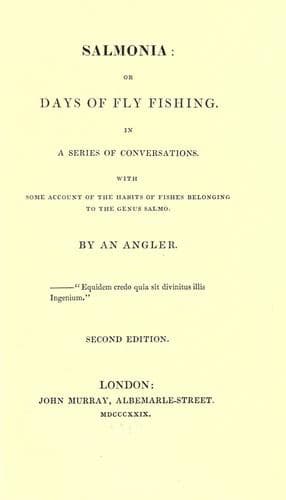
Salmonia; Or, Days of Fly Fishing: In a series of conversations. With some account of the habits of fishes belonging to the genus SalmoDavy, Humphry, Sir
Philosophy
Salmonia; Or, Days of Fly Fishing: In a series of conversations. With some account of the habits of fishes belonging to the genus Salmo
Davy, Humphry, Sir
Fishing
HAL.—Try at first the very top of the pool,—though I fear you will get
nothing there; but here is a cast which I think the Highlander can
hardly have commanded from the other side, and which is rarely without a
good fish. There, he rose: a large trout of 10lbs., or a salmon. Now
wait a few minutes. When a fish has missed the fly, he will not rise
again till after a pause—particularly if he has been for some time in
the fresh water. Now try him again. He has risen, but he is a dark fish
that has been some time in the water, and he tries to drown the fly with
a blow of his tail. I fear you will not hook him except foul, when most
likely he would break you. Try the bottom of the pool, below where I
caught my fish.
POIET.—I have tried all the casts, and nothing rises.
HAL.—Come, we will change the fly for that which I used.
POIET.—Now I have one: he has taken the fly under water, and I cannot
see him.
HAL.—Straighten your line, and we shall soon see him. He is a sea trout,
but not a large one.
POIET.—But he fights like a salmon, and must be near 5lbs.
HAL.—Under 3lbs.; but these fish are always strong and active, and
sometimes give more sport than larger fish. Shorten your line, or he
will carry you over the stones and cut the link gut. He is there
already: you have allowed him to carry out too much line; wind up as
quick as you can, and keep a tight hand upon him. He is now back to a
good place, and in a few minutes more will be spent. I have the net.
There, he is a sea trout of nearly 3lbs. This will be a good addition to
our dinner: I will crimp him, that you may compare boiled sea trout with
broiled, and with salmon. Now, if you please, we will cool this fish at
the spring, and then go to our inn.
POIET.—If you like. I am endeavouring to find a reason for the effect of
crimping and cold in preserving the curd of fish. Have you ever thought
on this subject?
HAL.—Yes: I conclude that the fat of salmon between the flakes of the
muscles is mixed with much albumen and gelatine, and is extremely liable
to decompose, and by keeping it cool, the decomposition is retarded; and
by the boiling salt and water, which is of a higher temperature than
that of common boiling water, the albumen is coagulated, and the
curdiness preserved. The crimping, by preventing the irritability of the
fibre from being gradually exhausted, seems to preserve it so hard and
crisp, that it breaks under the teeth; and a fresh fish not crimped is
generally tough. A friend of mine, an excellent angler, has made some
experiments on the fat of fish; and he considers the red colour of
trout, salmon, and char, as owing to a peculiar coloured oil, which may
be extracted by alcohol; and this accounts for the want of it in fish
that have fed ill, and after spawning. In general, the depth of the red
colour and the quantity of curd are proportional.
Public-domain text, read in full here on John Shaqi.
Reviews
Reviews
No reviews yet
Be the first to share your thoughts on this work.
Join the Discussion
Join the discussion
Sign in to leave a comment or review.
Sign InorCreate an account