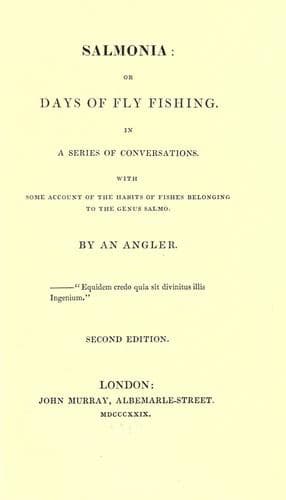
Salmonia; Or, Days of Fly Fishing: In a series of conversations. With some account of the habits of fishes belonging to the genus SalmoDavy, Humphry, Sir
Philosophy
Salmonia; Or, Days of Fly Fishing: In a series of conversations. With some account of the habits of fishes belonging to the genus Salmo
Davy, Humphry, Sir
Fishing
ORN.—I find I must multiply examples. Examine young ducks which have
been hatched under a hen; they no sooner quit the shell, than they fly
to their natural element, the water, in spite of the great anxiety and
terror of their foster-parent, who in vain repeats that sound to which
her natural children are so obedient. Being in the water, they seize
insects of every kind, which they can only know from their instincts to
be good for food; and when they are hatched in the May-fly season, they
pursue these large ephemeræ with the greatest avidity, and make them
their favourite food. It is impossible, I think, to explain these facts,
except by supposing, that they depend upon feelings or desires in the
animals developed with their organs, which are not acquired, and which
are absolutely instinctive. I will mention another instance. A friend of
mine was travelling in the interior of Ceylon; on the banks of a lake he
saw some fragments of shells of the eggs of the alligator, and heard a
subterraneous sound: his curiosity was excited, and he was induced to
search beneath the surface of the sand: besides two or three young
animals lately come from the shell, he found several eggs which were
still entire: he broke the shell of one of them, when a young alligator
came forth, apparently perfect in all its functions and motions; and
when my friend touched it with a stick, it assumed a threatning aspect,
and bit the stick with violence. It made towards the water, which
(though born by the influence of the sunbeams on the burning sand) it
seemed to know was its natural and hereditary domain. Here is an animal
which, deserted by its parents, and entirely submitted to the mercy of
nature and the elements, must die if it had to acquire its knowledge;
but all its powers are given, all its wants supplied; and even its means
of offence and defence implanted by strong and perfect instincts. I will
mention one fact more. Swallows, quails, and many other birds, migrate
in large flocks when their usual food becomes scarce; and in these cases
it may be said (I anticipate a remark of Physicus), that the phenomenon
depends upon imitation, and that the young birds follow the old ones who
have before made the same flight. But I will select the young cuckoo for
an unexceptionable example of the instinctive nature of this quality. He
is produced from an egg deposited by his mother in the nest of another
bird, generally the hedge sparrow. He destroys all the other young ones
hatched in the same nest, and is supplied with food by his
foster-parent, after he has deprived her of all her natural offspring.
Quite solitary, he is no sooner able to fly than he quits the country of
his birth, and finds his way, with no other guide than his instinct, to
a land where his parents had gone many weeks before him; and he is not
pressed to make this migration by want of food, for the insects and
grains on which he feeds are still abundant. The whole history of the
Public-domain text, read in full here on John Shaqi.
Reviews
Reviews
No reviews yet
Be the first to share your thoughts on this work.
Elsewhere in the archive
Join the Discussion
Join the discussion
Sign in to leave a comment or review.
Sign InorCreate an account