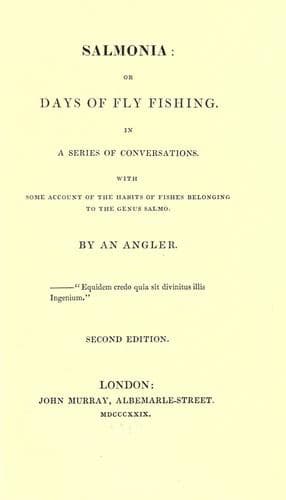
Salmonia; Or, Days of Fly Fishing: In a series of conversations. With some account of the habits of fishes belonging to the genus SalmoDavy, Humphry, Sir
Philosophy
Salmonia; Or, Days of Fly Fishing: In a series of conversations. With some account of the habits of fishes belonging to the genus Salmo
Davy, Humphry, Sir
Fishing
origin, education, and migration of this singular animal, is a history
of a succession of instincts, the more remarkable, because in many
respects contrary to the usual order of nature.
PHYS.—I have been accustomed to refer many of the supposed instincts of
animals, such as migrations, building nests, and selection of food, to
imitation; but, I confess, I cannot explain the last fact you have
brought forward on this principle. Pray, Ornither, let me state your
view, as I understand it, that we may not differ as to the meaning of
language. I conclude you adopt Hartley’s view of association, that the
motions of the muscles in man are first automatic, and become voluntary
by association; and that reason is the application of voluntary motions
for a particular end. For instance: a child is not afraid of fire, but,
bringing its hand near the fire, it is burnt, and the convulsions of the
muscles produced by the pain ends in removing the hand from the source
of pain. These motions by association are made voluntary; and after this
experiment he avoids the fire by _reason_, and takes care always to
perform those motions which remove his limbs from this destructive
agent. But in contrasting instinct with this slow process, you would
say, most animals, without having felt the effects of fire, have an
innate dread of it; and in the same way, without having been taught, or
experienced pleasure or pain from the object, young ducks seek the
water, young chickens avoid it: their organs have a fitness or unfitness
for certain functions, and they use them for these functions without
education. In short, the instinctive application of the organ is
independent of experience, and forms part of a train of pure sensations.
ORN.—I have no objection to the statement you make of my view of the
subject; but I certainly should give to it a little more refinement and
generality. In all the results of reason, ideas are concerned but never
in those of instinct. Without memory there can be no reason; but in
instinct nothing can be traced but pure sensation.
POIET.—Though in the animal world no ideas seem connected with
instincts, yet they are all intended for specific and intelligent ends.
Thus the swallow travels to a country where flies are found; the salmon
migrates from the sea to the sources of fresh rivers, where its eggs may
receive a supply of aerated water, and without this migration the race
would be extinct: and in this way all the instincts of animals may be
referred to intelligence, which, though not belonging to the animal,
must be attributed to the Divine Mind. Is it not then reasonable to
refer instinct to the immediate impulse of the Author of Nature upon his
creatures? His omnipresence and omnipotence cannot be doubted, and to
the infinite mind the past, the present, and the future are alike; and
creative and conservative power must equally belong to it.
Public-domain text, read in full here on John Shaqi.
Reviews
Reviews
No reviews yet
Be the first to share your thoughts on this work.
Elsewhere in the archive
Join the Discussion
Join the discussion
Sign in to leave a comment or review.
Sign InorCreate an account