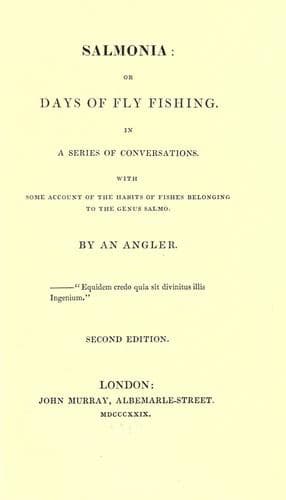
Salmonia; Or, Days of Fly Fishing: In a series of conversations. With some account of the habits of fishes belonging to the genus SalmoDavy, Humphry, Sir
Philosophy
Salmonia; Or, Days of Fly Fishing: In a series of conversations. With some account of the habits of fishes belonging to the genus Salmo
Davy, Humphry, Sir
Fishing
it were, with the primrose and the daisy; to wander upon the fresh turf
below the shade of trees, whose bright blossoms are filled with the
music of the bee; and on the surface of the waters to view the gaudy
flies sparkling like animated gems in the sunbeams, whilst the bright
and beautiful trout is watching them from below; to hear the twittering
of the water-birds, who, alarmed at your approach, rapidly hide
themselves beneath the flowers and leaves of the water-lily; and as the
season advances, to find all these objects changed for others of the
same kind, but better and brighter, till the swallow and the trout
contend as it were for the gaudy May fly, and till in pursuing your
amusement in the calm and balmy evening, you are serenaded by the songs
of the cheerful thrush and melodious nightingale, performing the offices
of paternal love, in thickets ornamented with the rose and woodbine.
PHYS.—All these enjoyments might be obtained without the necessity of
torturing and destroying an unfortunate animal, that the true lover of
nature would wish to see happy in a scene of loveliness.
HAL.—If all men were Pythagoreans and professed the Brahmin’s creed, it
would undoubtedly be cruel to destroy any form of animated life; but if
fish are to be eaten, I see no more harm in capturing them by skill and
ingenuity with an artificial fly, than in pulling them out of the water
by main force with the net; and in general, when taken by the common
fishermen, fish are permitted to die slowly, and to suffer in the air,
from the want of their natural element; whereas, every good angler, as
soon as his fish is landed, either destroys his life immediately, if he
is wanted for food, or returns him into the water.
PHYS.—But do you think nothing of the torture of the hook, and the fear
of capture, and the misery of struggling against the powerful rod?
HAL.—I have already admitted the danger of analysing, too closely, the
moral character of any of our field sports; yet I think it cannot be
doubted that the nervous system of fish, and cold-blooded animals in
general, is less sensitive than that of warm-blooded animals. The hook
usually is fixed in the cartilaginous part of the mouth, where there are
no nerves; and a proof that the sufferings of a hooked fish cannot be
great is found in the circumstance, that though a trout has been hooked
and played for some minutes, he will often, after his escape with the
artificial fly in his mouth, take the natural fly, and feed as if
nothing had happened; having apparently learnt only from the experiment,
that the artificial fly is not proper food. And I have caught pikes with
four or five hooks in their mouths, and tackle which they had broken
only a few minutes before; and the hooks seemed to have had no other
effect than that of serving as a sort of _sauce piquante_, urging them
to seize another morsel of the same kind.
Public-domain text, read in full here on John Shaqi.
Reviews
Reviews
No reviews yet
Be the first to share your thoughts on this work.
Join the Discussion
Join the discussion
Sign in to leave a comment or review.
Sign InorCreate an account