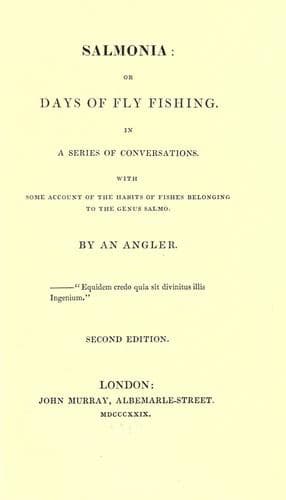
Salmonia; Or, Days of Fly Fishing: In a series of conversations. With some account of the habits of fishes belonging to the genus SalmoDavy, Humphry, Sir
Philosophy
Salmonia; Or, Days of Fly Fishing: In a series of conversations. With some account of the habits of fishes belonging to the genus Salmo
Davy, Humphry, Sir
Fishing
HAL.—Most willingly. I have even made a hook, which, though a little
inferior in form, in other respects, I think, I could boast as equal to
the Limerick ones. The first requisite in hook-making is to find good
malleable iron of the softest and purest kind—such as is procured from
the nails of old horse-shoes. This must be converted by cementation with
charcoal into good soft steel, and that into bars or wires of different
thickness for different sized hooks, and then annealed. For the larger
hooks, the bars must be made in such a form as to admit of cutting the
barbs; and each piece, which serves for two hooks, is larger at the
ends, so that the bar appears in the form of a double pointed spear,
three, four, or five inches long: the bars for the finer hooks are
somewhat flattened. The artist works with two files, one finer than the
other for giving the point and polishing the hook, and he begins by
making the barb, taking care not to cut too deep, and filing on a piece
of hard wood, such as box wood, with a dent to receive the bar, made by
the edge of the file. The barb being made, the shank is thinned and
flattened, and the polishing file applied to it; and by a turn of the
wrist round a circular pincers, the necessary degree of curvature is
given to it. The hook is then cut from the bar, heated red hot, by being
kept for a moment in a charcoal fire; then plunged, while hot, into cold
water; then tempered, by being put on iron, that has been heated in the
same fire till it becomes a bright blue, and, whilst still hot, it is
immersed in candle-grease, where it gains a black colour; it is then
finished.
PHYS.—Nothing seems simpler than this process. Surely London might
furnish manufacturers for so easy a manipulation; and I should think one
of our friends, who is so admirable a cutler, might even improve upon
the Irish process; at least the tempering might be more scientifically
arranged; for instance, by the thermometer, and a bath of fusible metal,
the temperature at which steel becomes blue being 580° Fahrenheit, might
be constantly preserved.
HAL.—Habit teaches our Irish artists this point with sufficient
precision. We should have such hooks in England, but the object of the
fishing tackle makers is to obtain them cheap, and most of their hooks
are made to sell, and good hooks cannot be sold but at a good price.
POIET.—I have heard formerly a good angler complain, that the Limerick
hooks were too heavy and clumsy. He preferred hooks made at Kendal in
Cumberland.
Public-domain text, read in full here on John Shaqi.
Reviews
Reviews
No reviews yet
Be the first to share your thoughts on this work.
Elsewhere in the archive
Join the Discussion
Join the discussion
Sign in to leave a comment or review.
Sign InorCreate an account