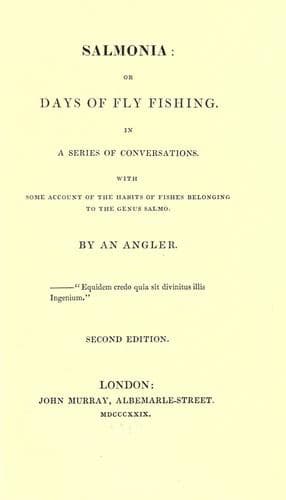
Salmonia; Or, Days of Fly Fishing: In a series of conversations. With some account of the habits of fishes belonging to the genus SalmoDavy, Humphry, Sir
Philosophy
Salmonia; Or, Days of Fly Fishing: In a series of conversations. With some account of the habits of fishes belonging to the genus Salmo
Davy, Humphry, Sir
Fishing
HAL.—I saw, twenty years ago, hooks far too heavy made at Limerick; but
this O’Shaughnessy is, I think, a better maker than his father was, and
the curve and the general form of the hook is improved. It has now, I
think, nearly the best form of a curve for catching and holding, the
point protruding a little. The Kendal hook holds well, but is not so
readily fixed by the pull in the mouth of the fish. The early Fellows of
the Royal Society, who attended to all the useful and common arts, even
improved fish hooks; and Prince Rupert, an active member of that
illustrious body, taught the art of tempering hooks to a person of the
name of Kirby; under whose name, for more than a century, very good
hooks were sold. I shall take a walk towards the lake to enjoy a view of
its cloud-capped mountains, and I hope to find, on my return, that you
have all had your satisfaction in a good day’s salmon fishing.
PHYS.—We shall crimp and cool a salmon, if we catch a good one, for our
dinner.
HAL.—Do so.
ORN.—But before you leave us, I wish you would be good enough to inform
us why the salmon here are so different from those I have seen
elsewhere: for instance, some caught in the Alness, in Rosshire, which
we saw in passing round the south coast of Ross. These appear to me
thicker and brighter fish, and one that I measured was 30 inches long,
and 17 in circumference.
HAL.—I think I have seen broader fish than even those of this river; but
the salmon which you happen to remember for comparison, belonged to a
small stream, which, I think, in general, are thinner and longer than
those in great rivers; and what I mentioned on a former occasion with
respect to trout holds good likewise with regard to salmon; each river
has a distinct kind. It is scarcely possible to doubt, that the
varieties of the salmon, which haunt the sea, come to the same rivers to
breed in which they were born, or where they have spawned before. And
this could hardly happen unless they confined their migrations to a
certain space in the sea, the boundaries of which may be regarded as the
shore and probably deep water, which may be considered as effectual a
limit almost as land; for fish do not willingly haunt _very_ deep water,
which even in summer is of low temperature, approaching to 40°, and
contains little or no vegetable food or insects, which the smaller
fishes search for, and the larger fishes follow the smaller. It is
however possible, that in winter, all fish fond of heat will seek water
rather deeper than in summer; and char and umbla in lakes are usually
found in the deepest parts, being fond of _cool_ water, and they come to
spawn whenever the shallow water of the lakes becomes cool, in October
or November. We cannot judge of the senses of animals that breathe
water,—that separate air from water by their gills; but it seems
probable, that, as the quality of the water is connected with their life
and health, they must be exquisitely sensible to changes in water, and
Public-domain text, read in full here on John Shaqi.
Reviews
Reviews
No reviews yet
Be the first to share your thoughts on this work.
Elsewhere in the archive
Join the Discussion
Join the discussion
Sign in to leave a comment or review.
Sign InorCreate an account