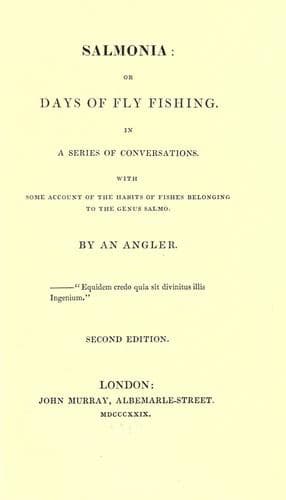
Salmonia; Or, Days of Fly Fishing: In a series of conversations. With some account of the habits of fishes belonging to the genus SalmoDavy, Humphry, Sir
Philosophy
Salmonia; Or, Days of Fly Fishing: In a series of conversations. With some account of the habits of fishes belonging to the genus Salmo
Davy, Humphry, Sir
Fishing
HAL.—I think you are mistaken. Salmon are usually shyer even than trout,
and I never knew one in this season, that had been pricked even
slightly, rise again at the artificial fly in the same pool. I should
say, that their habits were precisely the same, but with more sagacity
on the side of the salmon. It must have been another fish that rose at
your fly in the same place. After such severe discipline, I do not think
a fish would rise for many hours, even at a natural bait.
POIET.—Your experience is so great, that I dare say I was mistaken, yet
it seemed a fish of the same size.
HAL.—Salmon often in this season haunt the streams in pairs; but so far
from rising again after being pricked, they appear to me to learn, when
they have been some time in the river, that the artificial fly is not
food, even without having been touched by the hook. In the river at
Galway, in Ireland, I have seen above the bridge some hundreds of salmon
lying in rapid streams, and from five to ten fishermen tempting them
with every variety of fly, but in vain. After a fish had been thrown
over a few times, and risen once or twice and refused the fly, he rarely
ever took any notice of it again in that place. It was generally nearest
the tide that fish were taken, and the place next the sea was the most
successful stand, and the most coveted; and when the water is low and
clear in this river, the Galway fishermen resort to the practice of
fishing with a naked hook, endeavouring to entangle it in the bodies of
the fish; a most unartistlike practice. In spring fishing, I have known
a hungry, half-starved salmon rise at the artificial fly a second time,
after having been very slightly touched by it; but even this rarely
happens, and when I have seen it, the water has been coloured.
PHYS.—Can you tell us why the fish rise better at the fly when the tide
is flowing, than when it is ebbing? There seems no reason why flies
should be sought for by the fish at one of these seasons, rather than at
the other.
HAL.—The turn of the salt water brings up aquatic insects, and perhaps
small fish; and I suppose salmon know this, and search for food at a
time when it is likely to be found. I cannot think, that in these pools
they can be on the look-out for flies, for there are never any on the
surface of the water; and I imagine they take the gaudy fly, with its
blue kingfisher and golden pheasant’s feathers, for a small fish.
ORN.—I have always supposed that they took it for a libella, or
dragon-fly; for I have often seen these brilliant flies haunting the
water.
Public-domain text, read in full here on John Shaqi.
Reviews
Reviews
No reviews yet
Be the first to share your thoughts on this work.
Elsewhere in the archive
Join the Discussion
Join the discussion
Sign in to leave a comment or review.
Sign InorCreate an account