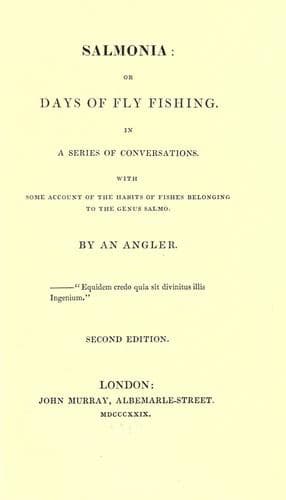
Salmonia; Or, Days of Fly Fishing: In a series of conversations. With some account of the habits of fishes belonging to the genus SalmoDavy, Humphry, Sir
Philosophy
Salmonia; Or, Days of Fly Fishing: In a series of conversations. With some account of the habits of fishes belonging to the genus Salmo
Davy, Humphry, Sir
Fishing
must have similar relations to it, that an animal with the most delicate
nasal organs has to air. A vulture or a dog scents not only particular
food and particular game at great distances, but even makes of the smell
a kind of language; and I doubt not, that when dogs, that have been
blindfolded and carried away from their home, return to it, it is by the
sense of smelling: to them each town, lane, or field, must have a
particular scent. And I have seen even a blind horse, an animal in which
the sense of smelling is less acute, evidently find his way by it to his
master’s house and stable, which was, indeed, near a tan-yard. The state
of parts of water, in the sea or great lakes, produced by the
impregnations carried down by particular streams, is much more permanent
than a _like state_ in air: so that though the knowledge given by the
nasal organs may be more easily communicated at a distance by winds, yet
_that_ produced by streams on the bronchiæ of fishes is more invariable,
and a migratory fish is less likely to be deceived. Yet in great floods,
often connected with storms, or violent motion in the waters near the
shore, salmon sometimes mistake their river. I remember in this way,
owing to a tremendous flood, catching with the fly a large salmon, that
had mistaken his river, having come into the Bush, near the Giant’s
Causeway, instead of the Bann. No fish can be more distinct in the same
species than the fish of these two rivers, their length to their girth
being nearly in a ratio of 20:9 and 20:13.—I am going; good sport to
you.
EVENING.
HAL.—I am sure I may congratulate you on your sport, for I see on the
bank a fine salmon, three grauls or grilses, and three large sea trout.
ORN.—You have not seen all, for we have crimped two fish—one a large
salmon, and the other a trout almost a yard long, and both in excellent
season. We have had great sport, and sport even of a kind which you will
not guess at; for, when the tide was falling, the fish ceased to rise at
the fly, and I thought of trying them with a bait; so we sent for our
swivel tackle, and put par or samlet on our hooks, as we bait for
pike—cutting off one ventral fin on one side, and one pectoral fin on
the other; and making the par spin in the most rapid streams, we had
several runs from fish, and it was in this way that Poietes caught this
large sea trout, which gave excellent sport.
HAL.—This kind of fishing is not uncommon. I have often caught salmon in
the Tay, fishing with pars; but though the fish ran at the bait, when
they would not rise at the fly while the tide was ebbing, they would
have taken the par better still while it was flowing.
PHYS.—From my experience to-day, I conclude the salmon has habits
different from the trout; for I think the fish which broke my hook rose
again at the artificial fly in the same place.
Public-domain text, read in full here on John Shaqi.
Reviews
Reviews
No reviews yet
Be the first to share your thoughts on this work.
Elsewhere in the archive
Join the Discussion
Join the discussion
Sign in to leave a comment or review.
Sign InorCreate an account