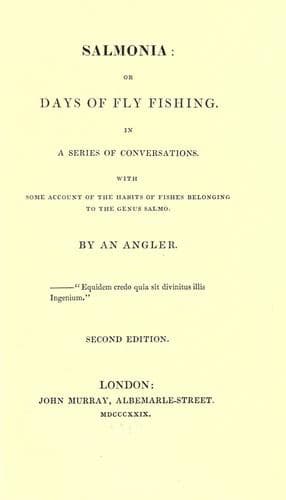
Salmonia; Or, Days of Fly Fishing: In a series of conversations. With some account of the habits of fishes belonging to the genus SalmoDavy, Humphry, Sir
Philosophy
Salmonia; Or, Days of Fly Fishing: In a series of conversations. With some account of the habits of fishes belonging to the genus Salmo
Davy, Humphry, Sir
Fishing
PHYS.—In my opinion, profound minds are the most likely to think lightly
of the resources of human reason: it is the pert, superficial thinker
who is generally strongest in every kind of unbelief. The deep
philosopher sees chains of causes and effects so wonderfully and
strangely linked together, that he is usually the last person to decide
upon the impossibility of any two series of events being independent of
each other; and in science, so many natural miracles, as it were, have
been brought to light,—such as the fall of stones from meteors in the
atmosphere, the disarming a thunder cloud by a metallic point, the
production of fire from ice by a metal white as silver, and referring
certain laws of motion of the sea to the moon,—that the physical
inquirer is seldom disposed to assert, confidently, on any abstruse
subjects belonging to the order of natural things, and still less so on
those relating to the more mysterious relations of moral events and
intellectual natures.
SEVENTH DAY.
HALIEUS—POIETES—ORNITHER—PHYSICUS.
GRAYLING FISHING.
_Scene—Leintwardine, near Ludlow._
_Time—Beginning of October._
HAL.—YOU have reached your quarters. Here is your home—a rural,
peaceable, and unassuming inn, with as worthy a host and hostess as may
be found in this part of the country. The river glides at the bottom of
the garden, and there is no stream in England more productive of
grayling. The surrounding scenery is not devoid of interest, and the
grounds in the distance are covered with stately woods, and laid out (or
rather their natural beauties developed) by the hand of a master, whose
liberal and enlightened mind even condescended to regard the amusements
of the angler; and he could hardly have contributed in a more effectual
manner to their comforts, than by placing the good people, who were once
his servants, in this comfortable inn.
PHYS.—Are we to fish according to any rule, as to quantity or size of
fish?
HAL.—You are at perfect liberty to fish as you like; but as it is
possible you may catch grayling only of this year, and which are not
longer than the hand, I conclude you will return such pigmies to the
river, as a matter of propriety, though not of necessity.
POIET.—This river seems formed of two other streams, which join above
our inn. What are the names of its sources?
HAL.—The small river to the left is called the Teme, or Little Teme, and
though the least stream, it gives name to the river: the other, and more
copious stream, is called the Clun. The Little Teme contains principally
trout; the Clun, both trout and grayling: but the fish are more abundant
in the meadows, between this place and Downton, than in other parts of
the river; for above, the stream is too rapid and shallow to be
favourable to their increase; and below, it is joined by other streams,
and becomes too abundant in coarse fish.
Public-domain text, read in full here on John Shaqi.
Reviews
Reviews
No reviews yet
Be the first to share your thoughts on this work.
Elsewhere in the archive
Join the Discussion
Join the discussion
Sign in to leave a comment or review.
Sign InorCreate an account