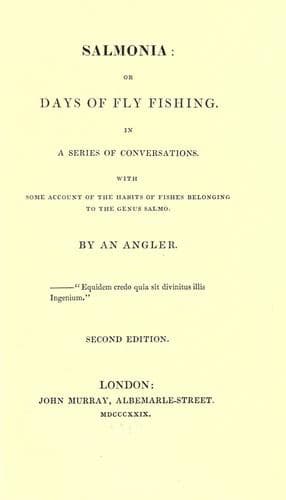
Salmonia; Or, Days of Fly Fishing: In a series of conversations. With some account of the habits of fishes belonging to the genus SalmoDavy, Humphry, Sir
Philosophy
Salmonia; Or, Days of Fly Fishing: In a series of conversations. With some account of the habits of fishes belonging to the genus Salmo
Davy, Humphry, Sir
Fishing
POIET.—I cannot understand why the grayling should be so scarce a fish
in England. It is abundant in many districts on the continent; but in
this island it is found, I believe, only in a few rivers, and does not
exist, I think, either in Ireland or Scotland. Yet, being an Alpine
fish, and naturally fond of cool water, it might have been expected
among the Highlands.
HAL.—I formerly used to account for this, by supposing it an _imported_
fish, and not indigenous; but, in some of my continental excursions, I
have seen it living only under such peculiar circumstances, that I doubt
the correctness of this my early opinion.
POIET.—Which was, I conclude, that it was introduced by the monks, in
the time when England was under the See of Rome. As a favourite fish of
St. Ambrose it was worth cultivating, as well as for its own sake; and I
think you have done wrong to relinquish this idea, for, as far as my
recollection serves me, the rivers that contain it are near the ruins of
great monasteries. The Avon, near Salisbury; the Ure, near Fountain’s
Abbey; the Wye, near the great Abbey of Tintern; and, if I am not
mistaken, in the lower part of this valley there are the remains of an
extensive establishment of friars.
HAL.—But there are rivers near the ruins of some of the most magnificent
establishments of this kind in Europe, and those nearest the continent,
where the grayling is not found; for instance, in the Stour, at
Canterbury. And if the grayling _be_ an imported fish, it is wonderful,
that it should not be found in the rivers in Kent, and along the
south-west coast of England, as in Dorsetshire, Devonshire, and
Cornwall, where the monastic establishments were numerous; and why it
should be found in some rivers in the mountainous parts of Wales, as in
that near Llan-wrted and the Dee; not near Val Crusis Abbey, but fifteen
miles higher up, between Corwen and Bala.
POIET.—It may have been a fish imported from the continent, and carried
to a number of rivers, only a few of which may have suited its habits,
and has remained there and multiplied.
HAL.—There may be truth in what you are now imagining, for the grayling
requires a number of circumstances in a river to enable it to increase.
POIET.—What circumstances are these?
HAL.—A temperature in the water which must be moderate—neither too high
nor too low. Grayling are never found in streams that run from
glaciers—at least near their source; and they are killed by cold or
heat. I once put some grayling from the Teme, in September, with some
trout, into a confined water, rising from a spring in the yard at
Downton; the grayling all died, but the trout lived. And in the hot
summer of 1825, great numbers of large grayling died in the Avon, below
Ringwood, without doubt killed by the heat in July.
POIET.—But I have heard of grayling being common in Lapland—at least so
says Linnæus.
Public-domain text, read in full here on John Shaqi.
Reviews
Reviews
No reviews yet
Be the first to share your thoughts on this work.
Elsewhere in the archive
Join the Discussion
Join the discussion
Sign in to leave a comment or review.
Sign InorCreate an account