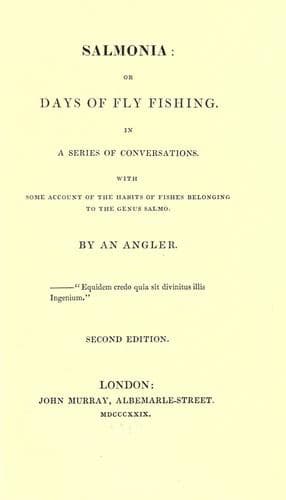
Salmonia; Or, Days of Fly Fishing: In a series of conversations. With some account of the habits of fishes belonging to the genus SalmoDavy, Humphry, Sir
Philosophy
Salmonia; Or, Days of Fly Fishing: In a series of conversations. With some account of the habits of fishes belonging to the genus Salmo
Davy, Humphry, Sir
Fishing
HAL.—This is certainly possible: there is no doubt, that, in many
successive generations, animals may be fitted to bear changes, which
would have destroyed their progenitors. It is said by Bloch, that
graylings are found in the Caspian Sea, and in the Baltic,—masses of
saline water; though, as I have proved, the grayling of England will not
bear even a brackish water, without dying. And notwithstanding the
severity of the winter in high northern latitudes, streams under the ice
may retain a temperature not much lower than some of the Alpine rivers.
I have seen grayling in Carniola, in a source at the hottest season not
quite 50°; and as, in large bodies of water, the deepest part, in frost,
is generally the warmest—about 40°, the degree at which water is
heaviest—I see no reason why grayling may not be habituated to such a
temperature—coolness being generally favourable to their existence. But
see, the fog which had filled the valley and hid the mountains from our
sight is clearing away, and I fear it will be a hot day. Before the sun
becomes too bright is the best time for fishing, in such a day as this.
As soon as the fog is fairly off, the water-flies will begin to appear,
and fish to sport.
PHYS.—I see the fog has already disappeared from the deep water in the
meadow, where I suppose the warmth of the air from the considerable mass
of the water, is greater; and which is further removed from the hills
sending down currents of cold air, from the mixture of which with the
moist warm air above the river this phenomenon is produced. I see some
yellow flies beginning to come out; they have already felt the influence
of the warm air: and look! a fish has just risen opposite that bank, and
he rises again: let us prepare our tackle.
POIET.—What flies shall we employ?
HAL.—I recommend at least three; for the grayling lies deeper and is not
so shy a fish as the trout; and, provided your link is fine, is not apt
to be scared by the cast of flies on the water. The fineness of the
link, and of the guts to which your flies are attached, is a most
essential point, and the clearer the stream the finer should be the
tackle. I have known good fishermen foiled by using a gut of ordinary
thickness, though their fly was of the right size and colour. Very
slender transparent gut of the colour of the water is one of the most
important causes of success in grayling fishing. Let me see your book: I
will select a fine stretcher. Now, for the lowest fly, use a
yellow-bodied fly, with red hackle for legs, and landrail’s wing: for
the second, a blue dun, with dun body; and for the highest, the claret
coloured body, with blue wings; and let your first dropper fly be about
three feet from the stretcher and from the other dropper, and let the
hanging link which attaches them be 3½ inches long.
PHYS.—There are several fish rising: I shall throw at that opposite—he
appears large.
HAL.—It is a trout and not a grayling.
PHYS.—How do you know?
Public-domain text, read in full here on John Shaqi.
Reviews
Reviews
No reviews yet
Be the first to share your thoughts on this work.
Elsewhere in the archive
Join the Discussion
Join the discussion
Sign in to leave a comment or review.
Sign InorCreate an account