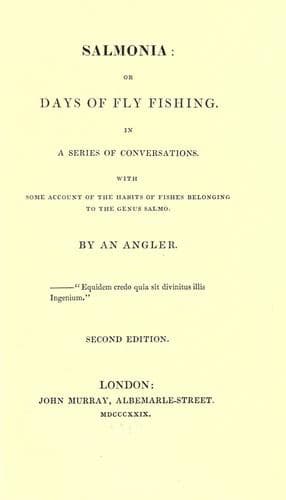
Salmonia; Or, Days of Fly Fishing: In a series of conversations. With some account of the habits of fishes belonging to the genus SalmoDavy, Humphry, Sir
Philosophy
Salmonia; Or, Days of Fly Fishing: In a series of conversations. With some account of the habits of fishes belonging to the genus Salmo
Davy, Humphry, Sir
Fishing
pools; and the slender nature of the body, towards the tail, renders
them much more unfit for leaping cataracts than trout and salmon. The
temperature of the water, and its character as to still and stream, seem
of more importance than clearness; for I have seen grayling taken in
streams, that are almost constantly turbid,—as in the Inn and the Salza
in the Tyrol. This fish appears to require food of a particular kind,
feeding much upon flies and their larvæ, and not usually preying upon
small fish, as the trout. It has a very strong stomach, in texture like
that of the gillaroo trout, and is exceedingly fond of those larvæ which
inhabit cases, and are usually covered with sand or gravel. I once
caught a grayling in the Wochain Save, that weighed about a pound and a
half, the stomach of which equalled in size a very large walnut, and
contained some small shells, and two or three white round pebbles as
large as small beans. In accordance with their general habits of
feeding, grasshoppers are amongst their usual food in the end of summer
and autumn; and at all seasons, maggots, upon fine tackle and a small
hook, offer a secure mode of taking them,—the pool having been
previously baited for the purpose of angling, by throwing in a handful
or two a few minutes before.
POIET.—You just now said, that you thought the Lapland fish, considered
by Linnæus as grayling, was the same as Back’s grayling; but I find, in
the Appendix to Captain Franklin’s narration, two graylings described as
belonging to the northern regions,—one the Coregonus Signifer, and
another, which appears to differ very little from it, except being small
in size. This seems to agree as nearly as possible with our grayling,
with a difference of at most one spine in the back fin. May not this in
fact be the same fish as the grayling of the Alps, only rendered in a
succession of generations fit for a colder climate?
Public-domain text, read in full here on John Shaqi.
Reviews
Reviews
No reviews yet
Be the first to share your thoughts on this work.
Elsewhere in the archive
Join the Discussion
Join the discussion
Sign in to leave a comment or review.
Sign InorCreate an account