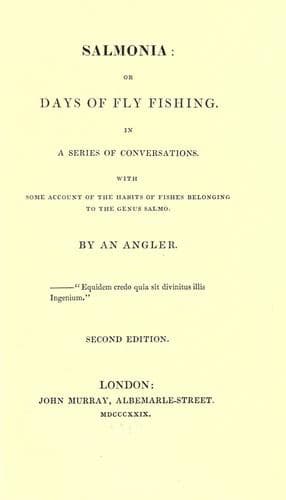
Salmonia; Or, Days of Fly Fishing: In a series of conversations. With some account of the habits of fishes belonging to the genus SalmoDavy, Humphry, Sir
Philosophy
Salmonia; Or, Days of Fly Fishing: In a series of conversations. With some account of the habits of fishes belonging to the genus Salmo
Davy, Humphry, Sir
Fishing
HAL.—The habits of the grayling, like those of most other fish, are very
simple. He is, I believe, to a certain extent, gregarious—more so than
the trout, and less so than the perch, and the usual varieties of the
carp species known in England. His form and appearance you have seen. He
is as yet scarcely in his highest or most perfect season, which is in
the end of November or beginning of December, when his back is very
dark, almost black, and his belly and lower fins are nearly
gold-coloured; but his brightness, like that of most other fishes,
depends a good deal upon the nature of the water: and on the continent I
have seen fishes far more brilliantly coloured than in England—the lower
part almost a bright orange, and the back fin approaching to the colour
of the damask rose, or rather of an anemone. The grayling spawns in
April, and sometimes as late as the beginning of May: the female is
generally then followed by two or three males. She deposits her ova in
the tales of sharp streams, and the males, rubbing against her, shed
upon the ova the melt or semi-fluid. I do not know how long a time is
required for the exclusion of the young ones; but in the end of July, or
beginning of August, they are of the size of sprats, four or five inches
long, and already sport merrily at a fly. Though I have often taken
grayling in bad season, yet I have rarely observed upon them the same
kind of leech,[7] or louse, which is so often found upon the trout; from
which I infer, that they seldom hide themselves, or become torpid in the
mud. The grayling hatched in May or June, I conclude, become the same
year, in September or October, nine or ten inches long, and weigh from
_five ounces_ to _half a pound_; and the year after they are from twelve
to fifteen inches long, and weigh from three-quarters to a pound; and
these two sizes, as you have seen, are the fish that most usually rise
at the fly. The first size in this river is called _shote_, which is a
Celtic word, I believe, applied likewise in the west of England to small
trout. Of their growth after the second year I cannot speak; this must
depend much on their food and place of residence. Marsigli says, they do
not grow after the third year, and at this age, in Austria, they are
sometimes a cubit long; but though I have fished much in that country, I
never saw any so long. If they are taken into new and comparatively
still water recently made, and where food is plenty, they grow very
fast: under these circumstances, I have seen them above 3lbs. In the
Test, where, as I mentioned before, the grayling has been only recently
introduced, they have sometimes been caught between 3 and 4lbs.—in this
river I never took one above 2lbs. but I have heard of one being taken
of 2½lbs. The grayling is a rare fish in England, and has never been
found in Scotland and Ireland (as Poietes observed before;) and there
are few rivers containing all the conditions necessary for their
increase.
Public-domain text, read in full here on John Shaqi.
Reviews
Reviews
No reviews yet
Be the first to share your thoughts on this work.
Elsewhere in the archive
Join the Discussion
Join the discussion
Sign in to leave a comment or review.
Sign InorCreate an account