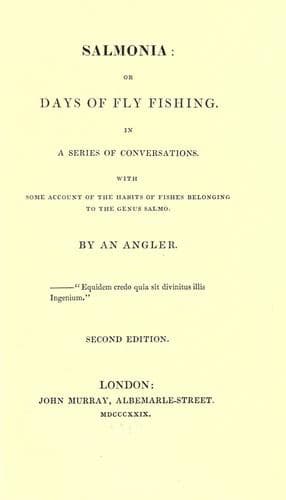
Salmonia; Or, Days of Fly Fishing: In a series of conversations. With some account of the habits of fishes belonging to the genus SalmoDavy, Humphry, Sir
Philosophy
Salmonia; Or, Days of Fly Fishing: In a series of conversations. With some account of the habits of fishes belonging to the genus Salmo
Davy, Humphry, Sir
Fishing
I know of no grayling river farther west than the Avon, in
Hampshire: they are found in some of the tributary streams of this river
which rise in Wiltshire. I know of no river containing them on the north
coast west of the Severn: there are very few only in the upper part of
this river, and in the streams which form it in North Wales. There are a
few in the Wye and its tributary streams. In the Lug, which flows
through the next valley, in Herefordshire, many grayling are found. In
the Dee, as I have said before, they are found, but are not common. In
Derbyshire and Staffordshire, the Dove, the Wye, the Trent, and the
Blithe, afford grayling; in Yorkshire, on the north coast, some of the
tributary streams of the Ribble,—and in the south, the Ure, the Wharfe,
the Humber, the Derwent, and the streams that form it, particularly the
Rye. There may be some other localities of this fish unknown to me; but
as I have fished much, and enquired much respecting the places where it
is found, I think my information tolerably correct and complete.
PHYS.—Is this fish to be fished for in spring?
HAL.—He is to be fished for at all times, for he is rarely so much out
of season as to be a bad fish; and when there are flies on the water, he
will generally take them: but as the trout may be considered as a spring
and summer fish, so the grayling may be considered as a winter and
autumnal fish.
PHYS.—Of course the grayling is taken in spring with the same imitation
of flies as the trout?
HAL.—The same. As far as flies are concerned, these two species feed
alike; though I may say, generally, that the grayling prefers smaller
flies, and the varieties of the ephemeræ or phryganeæ, of the smallest
size, form their favourite food. Yet grayling do not refuse large flies;
and in the Avon and Test, May flies, and even moths, are greedily taken
in the summer by large grayling. Flies, likewise, that do not inhabit
the water, but are blown from the land, are good baits for grayling.
There is no method more killing, for large grayling, than applying a
grasshopper to the point of a leaded hook, the lead and shank of which
are covered with green and yellow silk, to imitate the body of the
animal. This mode of fishing is called sinking and drawing. I have seen
it practised in this river with as much success as maggot fishing; and
the fish taken were all of the largest size; the method being most
successful in deep holes, where the bottom was not visible, which are
the natural haunts of such fish. In the winter, grayling rise for an
hour or two, in bright and tolerably warm weather; and, at this time,
the smallest imitations of black or pale gnats that can be made, on the
smallest sized hook, succeed best in taking them. In March, the
dark-bodied willow fly may be regarded as the earliest fly; the
imitation of which is made by a dark claret dubbing and a dun hackle, or
four small starling’s wing feathers. The blue dun comes on in the middle
Public-domain text, read in full here on John Shaqi.
Reviews
Reviews
No reviews yet
Be the first to share your thoughts on this work.
Elsewhere in the archive
Join the Discussion
Join the discussion
Sign in to leave a comment or review.
Sign InorCreate an account