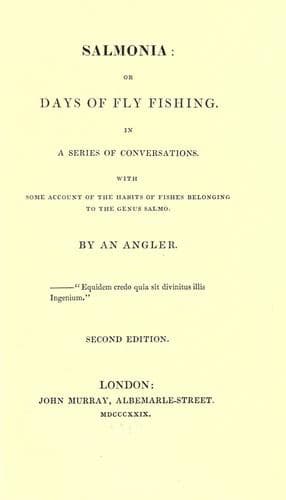
Salmonia; Or, Days of Fly Fishing: In a series of conversations. With some account of the habits of fishes belonging to the genus SalmoDavy, Humphry, Sir
Philosophy
Salmonia; Or, Days of Fly Fishing: In a series of conversations. With some account of the habits of fishes belonging to the genus Salmo
Davy, Humphry, Sir
Fishing
You must be acquainted with the origin
of our common house flies?
PHYS.—We know, that they spring from maggots, and that both the common
and blue bottle fly deposit their ova in putrid animal matter, were the
eggs are hatched and produce maggots, that, after feeding upon the
decomposing animal material, gradually change, gain a hard or horny
coat, seem as if entombed, and wait in a kind of apparent death or
slumber, till they are mature for a new birth, when they burst their
coatings and appear in the character of novel beings—fitted to inhabit
another element.
HAL.—The history of the birth and metamorphosis of all other winged
insects is very similar, but with peculiarities dependent upon their
organs, wants, and habits. You know the curious details with which we
have been furnished by natural historians of bees and ants, which live
in a kind of society. The ant flies, of which, as I mentioned to you,
imitations are sometimes used by fishermen, were originally maggots, and
became furnished with wings—not, however, passing through the aurelia
state for this last transformation.
POIET.—I beg your pardon, but, having lately read an account of these
animals in the very interesting book, called “An Introduction to
Entomology,” I think I can correct you in one particular; which is, that
the maggot of the ant _does_ assume the form of a chrysalis or pupa,
before it becomes a winged animal.
HAL.—It is true, that the _immediate_ transition of the maggot is into a
pupa, _then_ into an ant, which is furnished with a kind of case, from
which the wings emerge for their perfect transformation into the fly or
imago state. The males die soon after the sexual intercourse; the
females, when impregnated, lose their wings, and either voluntarily or
by force enter into society with neuter or working ants, for the purpose
of raising a new generation.
POIET.—You are perfectly right; and though it would be irrelevant to our
present object, I could almost wish, for the sake of amusing our
friends, that you would detail to us some other parts of the marvellous
history of these wonderful animals, which, if not so well authenticated,
might be supposed a philosophical romance. Such as the neuter or working
ants feeding each other and the offspring; the manner in which they
make, defend, and repair their dwellings, provide their food, watch and
attend to the female, and take care of her eggs; their extraordinary
mode of acquiring and defending the aphides and cocci, which bear to
them the same relation that cattle do to man, which are fed by them with
so much care, and the milk of which forms so important a part of their
food; the predatory excursions of a particular species to carry off
pupa, which they bring up as slaves.
Public-domain text, read in full here on John Shaqi.
Reviews
Reviews
No reviews yet
Be the first to share your thoughts on this work.
Elsewhere in the archive
Join the Discussion
Join the discussion
Sign in to leave a comment or review.
Sign InorCreate an account