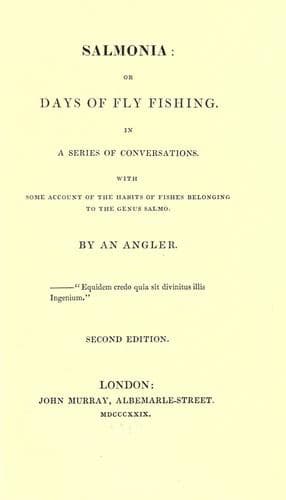
Salmonia; Or, Days of Fly Fishing: In a series of conversations. With some account of the habits of fishes belonging to the genus SalmoDavy, Humphry, Sir
Philosophy
Salmonia; Or, Days of Fly Fishing: In a series of conversations. With some account of the habits of fishes belonging to the genus Salmo
Davy, Humphry, Sir
Fishing
HAL.—To enter into any of the details of the history of insects in
society, would carry us into an interminable, though interesting
subject, that would soon lose all relation to fly fishing; and I fear
what I have to say, even on the winged insects connected with this
amusement, will occupy too much of your time, for we have not more than
an hour to devote to this object.
POIET.—Tell us what you please; we are attentive.
[Illustration: PHRYGANEÆ,
_With their Imitations._
_Frederick Sc._]
[Illustration: EPHEMERÆ
_With their Imitations or Hooks_
_Frederick Sc._]
[Illustration: EPHEMERÆ,
_With their Imitations or Hooks_
_Frederick Sc._]
HAL.—The various individuals of the _gryllus_, or grasshopper tribe,
spring from larvæ, that do not differ much from the perfect insect,
except in possessing no wings. The eggs are deposited in our meadows,
and many species of this animal are gregarious, and their immigrations
in swarms are well known. The butterfly and moths, as you know, lay eggs
which produce caterpillars, and these caterpillars, after feeding upon
vegetable food, spin themselves or frame houses or beds, cocoons, in
which they are transformed into aurelias, and from which they burst
forth as perfect winged insects. The _libellula_, or dragon fly, the
most voracious of the winged insect tribe, deposits her eggs in such a
manner, that the larvæ fall into the water, and, after destroying and
feeding upon almost all the aquatic insects found in this element, and
changing their skins at various times, they emerge in their winged form
the tyrants of the insect generations in the air. The gnats and tipulæ
have a similar existence. The gnat, the female of which only is said by
De Geer to bite man, or suck human blood, in Sweden, lays her egg in a
kind of little boat or cocoon of her own spinning. These eggs are
hatched on the surface of the water, and produce the larvæ, which
undergo another change into peculiar nymphæ, that still retain the power
of swimming and moving, from which the perfect insect is produced during
the summer heat. The flies, which I mentioned to you in a former
conversation, under the name of the grannom, or green tail, (_see fig._
2,) are of the class _phryganeæ_, which includes all those water flies
that have long antennæ, and wings something like those of moths, but
usually veined and without powder. The yellow flies, which you saw a
short time since sporting on the banks of the river, are of this kind.
The phryganeæ (_see fig._ 1, 2, 3, and 4,) have four wings, which, when
closed, lie flat on their backs, the two upper ones being folded over
the lower ones: the flies called by anglers the willow fly, the alder
fly, (_see fig._ 4,) and the dun cut, are of this kind. The phryganeæ
lay their eggs on the leaves of willows, or other trees, that overhang
the water; they are fastened by a sort of gluten to the surface of the
leaf: when hatched, they produce small hexapode larvæ, which fall into
Public-domain text, read in full here on John Shaqi.
Reviews
Reviews
No reviews yet
Be the first to share your thoughts on this work.
Elsewhere in the archive
Join the Discussion
Join the discussion
Sign in to leave a comment or review.
Sign InorCreate an account