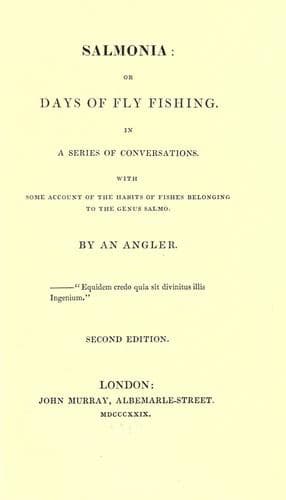
Salmonia; Or, Days of Fly Fishing: In a series of conversations. With some account of the habits of fishes belonging to the genus SalmoDavy, Humphry, Sir
Philosophy
Salmonia; Or, Days of Fly Fishing: In a series of conversations. With some account of the habits of fishes belonging to the genus Salmo
Davy, Humphry, Sir
Fishing
the water, and by a curious economy of nature collect round themselves,
some, parts of plants, or small sticks; some, gravel; and some, even
shell fish. They spin themselves a sort of case of silk from their
bodies, and by a gluten, that exudes from this case, cement their
materials together. They feed upon aquatic plants, and sometimes upon
insects, protruding only their head and legs from the case. When about
to undergo transmutation, they quit their cases, rise to the surface,
and wait for this process of nature in the air; but some species fix
themselves on plants or stones: they burst the skin of the larvæ, and
appear perfect animals, male and female, fitted for the office of
reproduction. In the early spring, the species which are called green
tails, from the colour of the bags of eggs in the female, appear in the
warm gleams of sunshine that happen in cloudy days, and they then cover
the face of the water, and are greedily seized on by the fish. As the
season advances they appear principally in the morning and evening. In
the heat of summer the phryganeæ are almost nocturnal flies, and seem to
have the habits of moths: at this season, _now_, I should say, the few
flies that appear are generally seen in the day-time. The _ephemeræ_,
another class of flies peculiarly interesting to the fisherman, differ
from the phryganeæ in carrying their wings perpendicularly on their
backs, and in having long filaments or hairs in their tails. The March
brown, (_see fig._ 8,) the various shades of duns, (_see fig._ 5, 6, and
7,) which I described to you on a former occasion; the green (_see fig._
9 and 10,) and white May fly, the red spinner, (_see fig._ 11,) are all
of the class ephemeræ. These flies are produced from larvæ which inhabit
the water, which can both crawl and swim, and which generally live in
holes they make in the bottom. They change their coats several times
before they become nymphæ. They quit their skin on the surface of the
water, but even after they are flies, they have another transformation
to undergo before they are perfect animals fitted for generation. They
make use of their wings only to fly to some dry bank, or trunk of a
tree, where they gradually disencumber themselves of the whole of the
outward habiliment they brought from the water, including their wings.
They become lighter, more beautiful in colour, and then begin their
sports in the sunshine—appearing like what might be imagined of spirits
freed from the weight of their terrestrial covering. This last
transmutation has been observed and fully described by some celebrated
naturalists, in the case of the May flies, and one or two other species,
and it probably will be found a general circumstance attached to the
class: I have often observed what appeared to me to be the cast-off
skins of the small species of ephemeræ on the banks of rivers and
floating in the water. The green ephemera, or May fly, lays her eggs
Public-domain text, read in full here on John Shaqi.
Reviews
Reviews
No reviews yet
Be the first to share your thoughts on this work.
Elsewhere in the archive
Join the Discussion
Join the discussion
Sign in to leave a comment or review.
Sign InorCreate an account