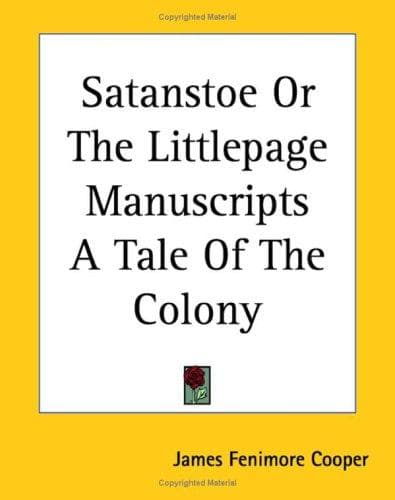
Satanstoe; Or, the Littlepage Manuscripts. A Tale of the ColonyCooper, James Fenimore
General
Satanstoe; Or, the Littlepage Manuscripts. A Tale of the Colony
Cooper, James Fenimore
Antirent War, N.Y., 1839-1846 -- Fiction
“That we can, sir, and a party that shall have its good players. Miss Mary
Wallace plays as good a hand at Whist, as a woman should, Mr. Worden; and
a very pretty accomplishment it is, for a lady to possess; useful, sir, as
well as entertaining; for anything is preferable to dummy. I do not think a
woman should play quite as well as a man, our sex having a natural claim to
lead, in all such things; but it is very convenient, sometimes, to find a
lady who can hold her hand with coolness and skill.”
“I would not marry a woman who did not understand Picquet,” exclaimed the
Rev. Mr. Worden; “to say nothing of Whist, and one or two other games. But,
let us be moving, since the hour is getting late.”
Move on we did, and in due time we all reached the place at which we were
to halt for the night. This looked like plunging into the wilderness
indeed; for the house had but two rooms, one of which was appropriated to
the use of the females, while most of us men took up our lodgings in
the barn. Anneke and Mary Wallace, however, showed the most perfect
good-humour; and our dinner, or supper might better be the name, was
composed of deliciously fat and tender broiled pigeons. It was the pigeon
season, the woods being full of the birds; and we were told, we might
expect to feast on the young to satiety.
About noon the next day, we reached the first clearing on the estate of
Ravensnest. The country through which we were travelling was rolling rather
than bold; but it possessed a feature of grandeur in its boundless forests.
Our route, that day, lay under lofty arches of young leaves, the buds just
breaking into the first green of the foliage, tall, straight columns,
sixty, eighty, and sometimes a hundred feet of the trunks of the trees,
rising almost without a branch. The pines, in particular, were really
majestic, most of them being a hundred and fifty feet in height, and a few,
as I should think, nearly if not quite two hundred. As everything grows
towards the upper light, in the forest, this ought not to surprise those
who are accustomed to see vegetation expand its powers in wide-spreading
tops, and low, gnarled branches that almost touch the ground, as is the
case in the open fields, and on the lawns of the older regions. As is usual
in the American virgin forest, there was very little underbrush; and we
could see frequently a considerable distance through these long vistas of
trees; or, indeed, until the number of the stems intercepted the sight.
Public-domain text, read in full here on John Shaqi.
Reviews
Reviews
No reviews yet
Be the first to share your thoughts on this work.
Elsewhere in the archive
Join the Discussion
Join the discussion
Sign in to leave a comment or review.
Sign InorCreate an account