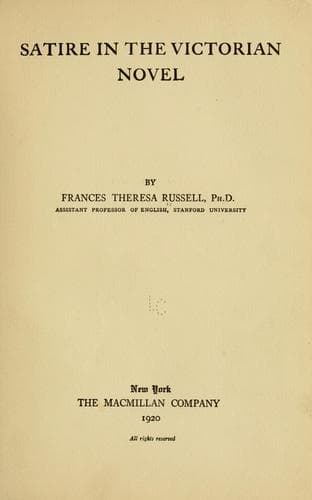
Satire in the Victorian novelRussell, Frances Theresa
History
Satire in the Victorian novel
Russell, Frances Theresa
English fiction -- 19th century -- History and criticism; Satire, English -- History and criticism; Thesis (Ph. D.)
So also was the _Anti-Jacobin_ designed as an instrument for the public
weal, though conceived in panic and brought forth in extravagance.
Both these productions, moreover, illustrate the difficulty of
distinguishing between personal and political or some sort of partisan
satire.[249] When Claudius was exposed on his bad eminence by Seneca,
Nero, by Persius, Domitian, by Juvenal, Wolsey, by Skelton, Napoleon
and George the Third, by Byron, and all four Georges, by Thackeray, it
was in every case, not as a mere human Doctor Fell, but as a crafty
tyrant or an incompetent mannikin made absurd by an incongruous
position of power and authority; although at first the personal
interest predominated over the political, the latter increasing with
time.
In any case, what has preserved personal satire in literature has been
the amber, not the flies. Such satiric portraits as are saved from
oblivion,--as those in _Absalom and Achitophel_, _Macflecknoe_, _The
Dunciad_, _The Vision of Judgment_,--are spared, not for their subjects
but for the wit in which they are dressed, irrespective of the justice
or the slander stitched into the costume.
In the field of prose fiction we find a comparatively small amount
of direct personal satire, and that modicum attached to the romantic
or fantastic section rather than the realistic. In the latter the
fusion of fact and fancy is too subtle to result in overt portraiture.
What Dickens says of Squeers is true in some degree of all fictitious
characters. All are drawn from observation, but none remain precisely
as observed, after passing through the crucible of their creator’s
imagination. Of some we chance to know more definitely than of others
that they were “taken from life.” Disraeli, for instance, in his
_Coningsby_, made the Honorable J. W. Croker into the politician Rigby,
Lord George Manners into Henry Sidney, and Lord Hertford into the Duke
of Monmouth. The last achieved his real immortality as the Marquis
of Steyne, and Theodore Hook also had the double honor of being the
original of Disraeli’s Lucian Gay and Thackeray’s Mr. Wagg. Richard
Monckton Milnes became the Vavasour of _Tancred_, John Bright, the Mr.
Turnbull of _Phineas Redux_, and Gerald Massey played the title rôle
in _Felix Holt_. We are aware too that their own families supplied
material to Dickens, Brontë, Eliot, and Meredith,[250] but we could
hardly class Mr. Micawber, Shirley Keeldar (or her friend Caroline
Helstone), Adam Bede, Dinah Morris, or Melchisedek Harrington as
examples of personal satire, even when given satirical treatment.
It is natural, therefore, that the member of our group who stands
preëminent in the line of individual satire is the one who also
heads the list chronologically; that the next are the two Victorian
forerunners; and that the only real Victorian left to complete this
small tale does it by virtue of his early work. After Thackeray’s
burlesques, ending about 1850, the personal species becomes practically
extinct.
Public-domain text, read in full here on John Shaqi.
Reviews
Reviews
No reviews yet
Be the first to share your thoughts on this work.
Elsewhere in the archive
Join the Discussion
Join the discussion
Sign in to leave a comment or review.
Sign InorCreate an account