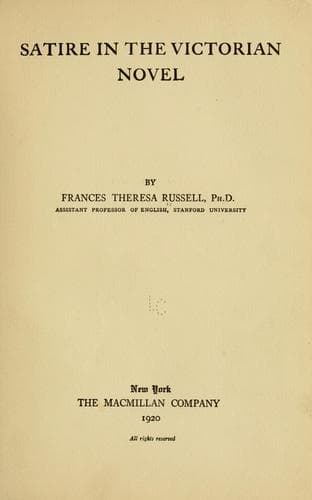
Satire in the Victorian novelRussell, Frances Theresa
History
Satire in the Victorian novel
Russell, Frances Theresa
English fiction -- 19th century -- History and criticism; Satire, English -- History and criticism; Thesis (Ph. D.)
Even more than usual, however, is the caution necessary that the
classification is artificial and the classes inseparable. An individual
may, and indeed generally does, represent an idea or an organization
or a certain temperament. Particularly when an object of satire, John
Doe is not viewed as John Doe but as an embodiment of some principle
or kind of conduct disapproved of by his critic. And conversely,
institutions and types, being abstractions, must be made concrete to
get them into workable shape. “The position of the satirist,” says
Lowell, in _The Bigelow Papers_, “is oftentimes one which he would
not have chosen, had the election been left to himself. In attacking
bad principles, he is obliged to select some individual who has made
himself their exponent, and in whom they are impersonate, to the end
that what he says may not, through ambiguity, be dissipated _tenues
in auras_.” Lowell was of course not unaware that the satirist’s
obligation might be met and fulfilled through the method of dramatic
disguise, but it is evident that the author of the _Fable for
Critics_ had his leanings toward the personal type. Yet he confirms
the pious English tradition by adding,--
“Meanwhile let us not forget that the aim of the true satirist
is not to be severe upon persons, but only upon falsehood. * * *
Truth is quite beyond the reach of satire. * * * The danger of
satire is, that continual use may deaden his sensibility to the
force of language.”
The real secret is that our primitive impulses clamor for the
delectable diet of personalities, and must be appeased by a little
judicious indulgence. Under pristine conditions, before we learned to
be apologetic for our instincts, we could enjoy our Fescinnine gibings
without a qualm. As we grew in poise and culture, we began to feel the
need of a finer diet for Cerberus, to gratify his acquired taste. Such
a sop was found in the altruistic motive, inexpensive and immediately
satisfying.
But, since motives are rarely single, there is frequently in this
unconscious pose an admixture of genuine idealism, most often of the
patriotic sort. _La Satire Ménippée_, for instance, was said to
have been worth as much to Henry of Navarre as was the battle of
Ivry; and its real object was the eternal one of good satire. Says a
historian,[248]
“All the mean political rivalries which pretend to work only for
the public good are exposed there; all those men who take God as
a shield to hide their own personal baseness, pass before us.”
Public-domain text, read in full here on John Shaqi.
Reviews
Reviews
No reviews yet
Be the first to share your thoughts on this work.
Elsewhere in the archive
Join the Discussion
Join the discussion
Sign in to leave a comment or review.
Sign InorCreate an account