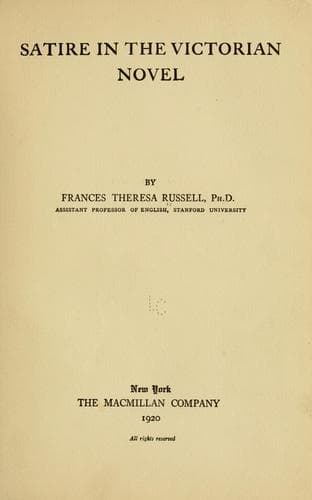
Satire in the Victorian novelRussell, Frances Theresa
History
Satire in the Victorian novel
Russell, Frances Theresa
English fiction -- 19th century -- History and criticism; Satire, English -- History and criticism; Thesis (Ph. D.)
But here, as everywhere, the complexity of this type obtrudes itself.
Most of the preceding illustrations have been concerned with men as
authors, that is to say, with certain products of literature; and
this puts them out of the personal class. The same thing is true of
Trollope’s sarcastic allusions to the novels of Disraeli and Dickens,
and Kingsley’s little flings at _Coningsby_ and Young England generally.
No comment on the whole matter of personal satire could be more to the
point or more conclusive than that given informally by Thackeray in a
couple of letters concerning his own attack on Lytton,--which he calls
by the right name. The first is addressed to Lady Blessington, and
accounts for his objection to E. L. B.[259]
“But there are sentiments in his writings which always anger me,
big words which make me furious, and a premeditated fine writing
against which I can’t help rebelling. My antipathy don’t go any
further than this.”
The other is written to Lytton himself, calling his attention to a
paragraph in his Preface to the 1856 edition of his (Thackeray’s)
Works; it is this that really contains the apology:
“There are two performances especially (among the critical and
biographical works of the erudite Mr. Yellowplush) which I am
very sorry to see reproduced, and I ask pardon of the author
of _The Caxtons_ for a lampoon which I know he himself has
forgiven, and which I wish I could recall. * * * I wonder at
the recklessness of the young man who could fancy such satire
was harmless jocularity, and never calculate that it might give
pain.”
This fine utterance, coming at just the right time and from the
right person,--the last of the personal satirists, reformed into the
author of _Vanity Fair_,--might be used as an appropriate epitaph for
individual satire. Since the time when Lamb observed that “Satire does
not look pretty upon a tombstone,” we have not only agreed with him,
but gone enough further to admit that it is no more winsome applied to
the living than to the dead. And if we still for the most part reserve
our eulogy until it can serve as elegy, we are willing to let the dead
past of spiteful, recriminating satire bury its dead.
It would not, as a matter of fact, be quite fair to the past to ignore
its own repudiation of this brackish current that has discolored the
main satiric stream. For it was undoubtedly this element that Cervantes
had in mind when he declared,--[260]
“My humble pen hath never winged its way
Athwart the field satiric, that low plain
Which leads to foul rewards, and quick decay.”
In the bitterly partisan seventeenth century Sir Thomas Browne
might well say, “It is seldom that men who care much for the truth
write satire.” And in the beginning of the next century we find the
confession,--[261]
Public-domain text, read in full here on John Shaqi.
Reviews
Reviews
No reviews yet
Be the first to share your thoughts on this work.
Elsewhere in the archive
Join the Discussion
Join the discussion
Sign in to leave a comment or review.
Sign InorCreate an account