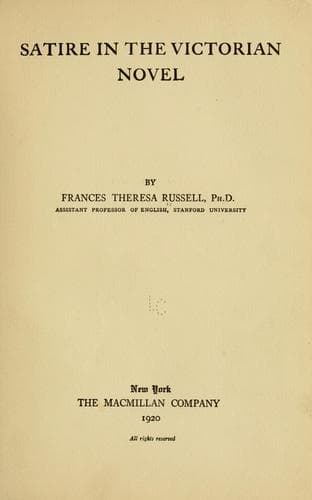
Satire in the Victorian novelRussell, Frances Theresa
History
Satire in the Victorian novel
Russell, Frances Theresa
English fiction -- 19th century -- History and criticism; Satire, English -- History and criticism; Thesis (Ph. D.)
“‘Not write!’ cried Satire, red as fire with rage:
‘This instant glorious war with dulness wage;
* * * * *
Flay half the Academic imps alive;
Smoke, smoke, the Drones of that stupendous Hive.’”
Later, made compunctious by the fable of the frogs pelted to death with
stones thrown merely in sport, he resolves to reform, but is dissuaded:
“‘Poh, poh!’ cried Satire with a smile,
‘Where is the _glorious freedom_ of our isle,
If not permitted to call names?’
Methought the argument had weight:
‘Satire,’ quoth I, ‘You’re very right;’
So once more forth volcanic Peter flames.”
“Life,” says Hawthorne, “is a mixture of marble and mud.” In this
particular fragment of life as represented in literature, we have
the two in paradoxical combination. Personal satire has the effect
sometimes of being an ugly little gargoyle made of marble, and
sometimes, of a harmonious form done in muddy clay. The ideal union of
matter and manner,--an Apollo in marble,--is not for such an impish
sculptor as satire. Only to the true artist, poetry, is allotted the
task of shaping beauty into rounded perfection.
CHAPTER II
INSTITUTIONS
Since institutions are satirized by those who take an interest in
public affairs, without being too well satisfied with the way they are
managed, we may expect to find them conspicuously under indictment
at this time. The Victorians were notably a public-spirited group,
and left no cranny unpenetrated by their critical searchlight; for
it was the lamp they used, and not the hammer. The two most striking
features of nineteenth century public satire are its ubiquity and its
moderation. In all departments it was zealous for reform; in none did
it see the need of sweeping abolishment. It emanated from a generation
poised waveringly between acquiescence and iconoclasm, but avoiding
both extremes. Awake to the blindness and blundering of the past, it
was still too rooted in piety and tradition to visualize a future
radically different. Strong remedies, falling short of the drastic and
destructive, seemed about the right prescription. Dudley Sowerby is
Victorianism incarnate:[265]
“* * * he had been educated in his family to believe, that the
laws governing human institutions are divine--until History
has altered them. They are altered, to present a fresh bulwark
against the infidel.”
The Victorians deplored, for instance, the domestic disaster that
inevitably follows the mercenary marriage encouraged by Society, but
they no more questioned the marriage ceremony than they would any
law of nature. _Getting Married_ does not merely happen to be
post-Victorian; it could not have been otherwise.
Public-domain text, read in full here on John Shaqi.
Reviews
Reviews
No reviews yet
Be the first to share your thoughts on this work.
Elsewhere in the archive
Join the Discussion
Join the discussion
Sign in to leave a comment or review.
Sign InorCreate an account