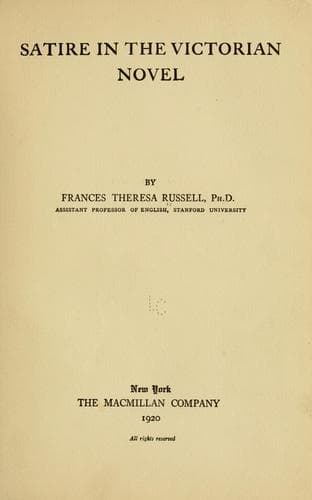
Satire in the Victorian novelRussell, Frances Theresa
History
Satire in the Victorian novel
Russell, Frances Theresa
English fiction -- 19th century -- History and criticism; Satire, English -- History and criticism; Thesis (Ph. D.)
They were also intensely partisan both as to Church and State,
according to the immemorial human habit; but none of them, not even
Disraeli or George Eliot, would refuse an amen to the invocation of
Charlotte Brontë:[266]
“Britain would miss her church, if that church fell. God save
it! God also reform it!”
Their Constitutional Monarchy was a broken reed, worse than useless,
yet _Anarchy_ was a fearful word, second only to _Atheism_ in horrific
import. As to the prevailing system of education, it was derided as
a failure and set down as naught; but we hear of no youth abjuring
college because it wasted his time and money.
Beyond these negative statements, however, the Victorians cannot be
described _en masse_, for individuality comes into play, both in
emphasis of interest and manner of attack. Nor is there throughout the
strictly Victorian period, any discernible evolution of ideas. From
Peacock to Kingsley the various novelists are to be distinguished only
by local color and personality. But the two whose lives actually extend
into the twentieth century are separated sharply in this matter from
their predecessors, and serve as links between their time and ours.
This omits only George Eliot, who belongs to the second group, although
she uses her modern scientific data seriously and not satirically.
With Meredith and Butler she forms a trio which faces resolutely with
the Course of Empire, while the others are more or less half-heartedly
saying their prayers toward the Orient.
As to the institutions themselves, started early in the human
stage through gregariousness and mutual dependence, and gradually
increased until now it is no longer possible for two or three to meet
together without organizing and equipping themselves with officers
and constitutions, any sort of classification must be as tentative,
interpenetrating, and unsatisfactory as are most topical outlines. But
a possible listing of satirized groups or provinces may be made under
half a dozen headings: Society, State, Church, School, Art, and Ideals.
By Society is meant that powerful but intangible influence that has a
name but no local habitation. It is in effect a federation of homes,
organized on the caste system. Known as “fashionable,” or “polite,”
its chief concern is with the lighter side of man’s life; with his
recreation if a worker, or his amusement if a drone. In view of the
fact that it is particularly the feminine domain, with the corollary
that Woman’s Place is in the Home, She, as a satirized class, belongs
here as appropriately as anywhere.
Public-domain text, read in full here on John Shaqi.
Reviews
Reviews
No reviews yet
Be the first to share your thoughts on this work.
Elsewhere in the archive
Join the Discussion
Join the discussion
Sign in to leave a comment or review.
Sign InorCreate an account