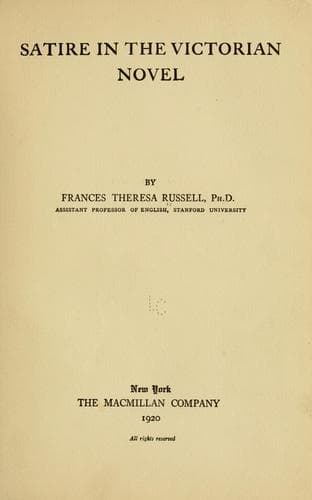
Satire in the Victorian novelRussell, Frances Theresa
History
Satire in the Victorian novel
Russell, Frances Theresa
English fiction -- 19th century -- History and criticism; Satire, English -- History and criticism; Thesis (Ph. D.)
The State includes such ramifications as politics, law, charities and
corrections, labor and capital, and warfare. It is in this connection
that satire may be defined, as by Myers, as “essentially a weapon of
the weak against the strong, of a minority against a majority;” and
by Besant in the same terms, the latter adding, “Satire began when
man began to be oppressed.” This statement occurs in his _French
Humourists_, and it is interesting to note the confirmation implied
in Lenient’s description of France suffering under oppression:
“_Esclave, elle tremble et obéit, mais se venge par la satire de ceux
qui lui font peur_.”
The Church, when allied with the State, assumed dominion not only over
it but over the Home as well. This last, indeed, was raised to the high
estate of an Institution by the joint ministrations of the other two.
By imposing Marriage upon it, they were enabled to lead it, often more
firmly than gently, between them; State grasping the right hand of Home
to insure legalization, and Church the left, to produce sanctification.
More recently Church and School have exchanged places in relation
to State, as education has become a public concern, and religion a
private. Art and Ideals, like Society, are not palpably crystallized,
but are useful designations. The main subject criticised in Art is that
branch to which the critics themselves belong, Literature. When Ideals
or Ideas are ridiculed, it is naturally as fallacious reasoning or
erroneous judgment. Attacks on civilization in general and the English
species of it in particular, may also be put here for want of a better
place.
According to the satirists, Society is at fault chiefly for its
worship of Mammon, its hollowness, and snobbish vanity. These lead to
artificial relationships, the most disastrous of which is the marriage
of convenience, which usurps the higher dominion of sentiment and
romance.
Peacock is interested not only in this matrimonial bargaining but in
the accompanying insistence on a decent disguise. Mr. Sarcastic is
pointing out the astonishing results to be secured by a practice of
absolute frankness in speech. Among other instances, he cites the shock
he gave Miss Pennylove by declaring to her,--[267]
“When my daughter becomes of marriageable age, I shall
commission Christie to put her up to auction, the highest bidder
to be the buyer, * * *”
In spite of the lady’s utter amazement and indignation, she afterwards
rejects manhood and love in favor of senility and wealth; whereby her
critic concludes,--
“How the dignity and delicacy of such a person could have been
affected, if the preliminary negotiation with her hobbling
Strephon had been conducted through the instrumentality of
honest Christie’s hammer, I cannot possibly imagine.”
Public-domain text, read in full here on John Shaqi.
Reviews
Reviews
No reviews yet
Be the first to share your thoughts on this work.
Elsewhere in the archive
Join the Discussion
Join the discussion
Sign in to leave a comment or review.
Sign InorCreate an account