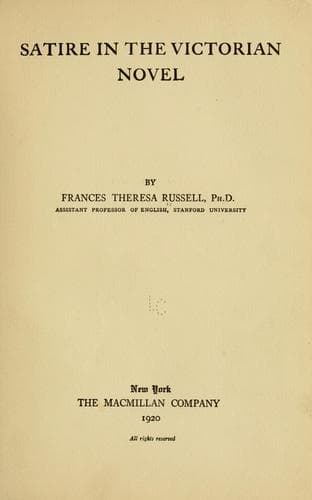
Satire in the Victorian novelRussell, Frances Theresa
History
Satire in the Victorian novel
Russell, Frances Theresa
English fiction -- 19th century -- History and criticism; Satire, English -- History and criticism; Thesis (Ph. D.)
“He wished for her to have come to him out of an egg shell,
somewhat more astonished at things than a chicken, but as
completely enclosed before he tapped the shell, and seeing him
with her sex’s eyes first of all men.”
In another of the late novels, the two abstractions, society and woman,
are fused in one description as,--[273]
“* * * the terrible aggregate social woman, of man’s creation,
hated by him, dreaded, scorned, satirized, and nevertheless,
upheld, esteemed, applauded: a mark of civilization, on to which
our human society must hold as long as we have nothing humaner.
She exhibits virtue, with face of waxen angel, with paw of
desert beast, and blood of victims on it.”
This is discrimination; the general dearth of which is lamented by Lady
Dunstane:[274]
“The English notion of women seems to be that we are born white
sheep or black; circumstances have nothing to do with our
colour. They dread to grant distinctions, and to judge of us
discerningly is beyond them.”
And Lætitia, after listening to a long Patterne discourse on feminine
traits and limitations, laconically sums up the whole matter in a
compact epigram:[275]
“‘The generic woman appears to have an extraordinary faculty for
swallowing the individual.’”
After this, decidedly flat and puerile falls the witticism of Kingsley,
spoken by Bracebridge in reply to Lancelot’s impatient question why
women would “make such fools of themselves with clergymen”:[276]
“They are quite right. They always like the strong men--the
fighters and the workers. In Voltaire’s time they all ran after
the philosophers. In the middle ages, books tell us, they
worshipped the knights errant. They are always on the winning
side, the cunning little beauties. In the war-time, when the
soldiers had to play the world’s game, the ladies all caught the
red-coat fever; now, in these talking and thinking days (and be
hanged to them for bores), they have the black-coat fever for
the same reason.”
Thackeray also is guilty of the generalization not at his time
discovered to be fallacious:[277]
“Women won’t see matters-of-fact in a matter-of-fact point of
view, and justice, unless it is tinged with a little romance,
gets no respect from them.”
The generosity of “Little Sister” in condoning young Firmin’s unwise
passiveness is based on “that admirable injustice which belongs to all
good women, and for which let us be daily thankful.” At this point the
undevout votary burns considerable medieval incense at the feminine
shrine,--not caring much if a little smoke should blow into his idols’
eyes:[278]
Public-domain text, read in full here on John Shaqi.
Reviews
Reviews
No reviews yet
Be the first to share your thoughts on this work.
Elsewhere in the archive
Join the Discussion
Join the discussion
Sign in to leave a comment or review.
Sign InorCreate an account